AI SBOM Compliance Guide
An enterprise practice guide that explains the requirements of the OpenChain AI SBOM Compliance Guide (Version 1.0) clause by clause.
This guide explains, one by one, each requirement of AI System Bill of Materials — Compliance
Management Guide for the Supply Chain (Version 1.0), published by the OpenChain AI Work Group.
It walks through what verification material each clause requires, how to comply with it, and
what samples and tools are ready to use.
This specification carries the same structure as ISO/IEC 5230, the open source license
compliance standard — requirements, verification material, and rationale — over into the AI
supply chain. It brings into scope not only code but also the licensing and transparency
obligations of model weights, training datasets, and the Model Tree.
Author : OpenChain Korea Work Group / CC BY 4.0
Note
All 10 requirements (3.1–3.10) per the specification body have been written. The compare page
that positions the standards relative to each other is still being expanded.
Intended Audience
- Compliance staff at organizations that develop AI systems or exchange them through the supply chain
- Practitioners who have an open source compliance (ISO/IEC 5230) program in place and want to extend it into AI
- Legal, security, and development staff who need to check the licensing and transparency obligations of AI models and datasets
How to Use This Guide
Division of Roles Between the OpenChain Specification and the KWG Practice Guide
The OpenChain specification defines “what must be demonstrated.” This guide fills in “how to
achieve it.” Each clause page does more than restate the specification’s requirements — it walks
through the actual procedures, samples, tools, and how to handle the parts that tools alone
cannot fill.
Notation — [Specification Requirement] vs [Guide Recommendation]
The content of each clause page falls into two categories.
- [Specification Requirement] — Items the AI SBOM Compliance Guide body specifies with
shall or as verification material. - [Guide Recommendation] — Items not found in the specification body but recommended by the
OpenChain Korea Work Group based on practical experience, best practices, and other standards
(ISO/IEC 5230, 42001, etc.). Adoption is at the organization’s discretion.
Activities presented alongside a verification material number (e.g., 3.1.1) are
[Specification Requirement]. Enhancements this guide adds, such as automation, tool use, and
intake gates, are [Guide Recommendation].
Note on Clause Numbering
The original specification’s table of contents and body section numbers are out of sync (the
“3.9 AI content review and approval” section listed in the table of contents does not appear in
the body, shifting all subsequent numbers down by one). This discrepancy has been reported to
the OpenChain AI Work Group. This guide follows the body’s section numbers (3.1–3.10).
Phased Implementation Roadmap
The 10 requirements are divided into four phases by implementation priority. Phase 1 establishes
the program’s foundation, Phase 2 builds AI-specific compliance processes, Phase 3 puts
operational structures in place, and Phase 4 establishes governance.
Phase 1 — Program Foundation
Goal: Define the program’s scope, establish policy, and secure competence and awareness.
| Done | Verification Material | Description | Detailed Guide |
|---|
| ☐ | 3.4.1 | Program scope statement | 3.4 → |
| ☐ | 3.1.1 | Documented AI SBOM policy | 3.1 → |
| ☐ | 3.1.2 | Policy awareness procedure | 3.1 → |
| ☐ | 3.2.1~3.2.3 | Role list, competence definitions, competence assessment evidence | 3.2 → |
| ☐ | 3.3.1 | Evidence of participant awareness assessment | 3.3 → |
Phase 2 — AI Extension Processes
Goal: Build AI-specific licensing, transparency, and SBOM processes that cover not just code
but also models, weights, and datasets. This is the area where the AI SBOM Guide expands most on
ISO/IEC 5230.
| Done | Verification Material | Description | Detailed Guide |
|---|
| ☐ | 3.5.1 | License obligation review and documentation procedure | 3.5 → |
| ☐ | 3.6.1 | Transparency obligation review procedure | 3.6 → |
| ☐ | 3.9.1 | AI SBOM identification, tracking, review, approval, and archiving procedure | 3.9 → |
| ☐ | 3.9.2 | Records demonstrating procedure compliance | 3.9 → |
Phase 3 — Operational Structure
Goal: Create a channel for responding to external compliance inquiries, and assign
accountability and resources to the program.
| Done | Verification Material | Description | Detailed Guide |
|---|
| ☐ | 3.7.1~3.7.2 | Public inquiry channel, internal response procedure | 3.7 → |
| ☐ | 3.8.1~3.8.5 | Role assignment, resources, legal expertise, remediation procedure | 3.8 → |
Phase 4 — Governance
Goal: Put in place a governance framework spanning the full AI system lifecycle, and reflect
emerging AI regulation.
| Done | Verification Material | Description | Detailed Guide |
|---|
| ☐ | 3.10.1 | AI governance framework and periodic review procedure | 3.10 → |
Full Clause Checklist
The body of the AI SBOM Compliance Guide consists of 10 clauses and 19 verification material
items in total (by this guide’s verification material numbering).
Total: 10 clauses / 19 verification material items
Automation Maturity Map
This is an honest breakdown of how far each AI SBOM compliance task is automated by tools today.
For “generation,” usable open source tools already exist. Interpreting license obligations and
tracking compliance with non-standard licenses, on the other hand, remain the work of people and
policy. Each clause page follows this line to distinguish “what a tool handles” from “what a
person must fill in.”
| Task | Automation Level | Representative Open Source Tool |
|---|
| Code/dependency SBOM generation | Mature | cdxgen, Syft |
| AI model/metadata BOM generation | Tools emerging | OWASP AIBOM Generator, cdxgen aibom mode |
| Static analysis of model binaries | Tools emerging | Lab700x AI SBOM Scanner |
| Identifying LLM inference servers and AI packages | Mature | Trivy, Syft |
| SBOM storage and vulnerability monitoring | Mature | Dependency-Track, SW360 |
| Interpreting license obligations, tracking non-standard compliance | Immature (people/policy) | Tool support still developing |
Generation by Tool, Interpretation by People
Several tools already generate AI SBOMs automatically. But whether the license fields in a
generated BOM are accurate, whether the behavioral use restrictions of non-standard licenses
(the RAIL family, the Llama Community License) are respected, and whether obligations propagate
downstream without being dropped — a tool cannot automatically guarantee any of this. Policy and
human review fill this gap. See 3.5 License Obligations
for details.
The installation and use of each tool is covered with execution screens and command output in
the Tools section.
Relationship to Other Standards
Relationship to ISO/IEC 5230 and 42001
- ISO/IEC 5230 (License Compliance): The AI SBOM Guide inherits the 5230 methodology
directly. Organizations that already have a 5230 program in place can reuse program
foundations such as policy, competence, and resources, and only need to add the AI extension
areas. See the ISO/IEC 5230 Compliance Guide.
- ISO/IEC 42001 (AI Management System): The technical details of AI SBOM formats (SPDX 3.0 AI
Profile, CycloneDX ML-BOM) and generation tools are covered in the
ISO/IEC 42001 Guide — AI SBOM.
Building on that, this guide focuses on “how to operate the compliance program.”
Original Specification
- Document: Artificial Intelligence System Bill of Materials — Compliance Management Guide for
the Supply Chain, Version 1.0
- Published: OpenChain Project AI Work Group, 2025-10-20
- License: Creative Commons Attribution 4.0 (CC-BY-4.0)
- Authoritative copy: Published as PDF and markdown in the OpenChain Reference-Material
repository (
AI-SBOM-Compliance/en) - Announcement: openchainproject.org
1 - Program Foundation
The stage of establishing the foundation of an AI SBOM compliance program. Covers policy, competency, awareness, and scope.
This is stage 1 of the implementation roadmap. It defines the program’s scope (3.4), establishes policy (3.1),
and secures the competency and awareness of participants (3.2, 3.3). All subsequent clauses operate on top of
this foundation.
1.1 - 3.1 Policy
Explains how to establish and communicate a written policy that governs AI SBOM compliance.
1. Clause Overview
Without an AI SBOM policy, an organization ends up deploying AI systems while developers remain
unaware of the licensing obligations attached to models and datasets. In AI, what needs to be
tracked goes beyond code. Model weights, training datasets, and the model tree derived from other
models each carry their own license, and non-standard licenses that restrict the purpose of use —
such as the Llama Community License or the RAIL family — are common. Missing these obligations
leads to copyright disputes, violations of usage restrictions, and terminated business contracts.
To prevent this risk, 3.1 requires establishing a documented policy that governs AI SBOM
compliance and communicating it so that program participants are aware of its existence. This
policy must reflect business strategy, the legal requirements of relevant jurisdictions, and the
level of risk appropriate to the use case. All subsequent clauses (competence, license
obligations, AI SBOM, governance, and so on) operate on top of this policy.
- Draft and formalize a policy document that governs AI SBOM compliance.
- Define the scope of application in the policy (AI systems deployed externally, external
models/datasets brought in, internal models released publicly, etc.).
- Reflect business strategy, the legal requirements of relevant jurisdictions, and the risk level
for each use case in the policy.
- Include in the policy a list of licenses allowed or prohibited for models and datasets.
([Guide Recommendation] Because compliance with non-standard licenses is hard to track
automatically after the fact, decide it through policy at intake time.)
- Establish and document a procedure for communicating the policy to program participants
(development, legal, security, data staff, etc.).
- Retain records that prove the policy was communicated (training completion, notice history, etc.).
- Include in the policy a procedure for periodically reviewing it and re-communicating it when it
changes.
3. Requirement and Verification Material
| Clause | Requirement | Verification Material |
|---|
| 3.1 | A written policy shall exist that governs AI SBOM compliance, and it shall be communicated internally. The policy shall reflect business strategy, the legal requirements of relevant jurisdictions, and the level of risk appropriate to the use case. | 3.1.1 A documented policy meeting the above requirement
3.1.2 A documented procedure that makes program participants aware of the existence of the policy (e.g., training, an internal wiki, or another practical communication method) |
View original English text
3.1 Policy
A written policy shall exist that governs AI System Bill of Materials (AI SBOM) compliance.
The policy shall be internally communicated, and informed by business strategy, legal
requirements in the relevant jurisdictions, and the level of risk appropriate for the use case.
Verification material(s):
- A documented policy meeting the above requirements
- A documented procedure that makes program participants aware of the existence of the policy
(e.g. via training, internal wiki or other practical communication method)
4. How to Comply with Each Verification Material, with Samples
3.1.1 Documented AI SBOM Policy
How to Comply
The AI SBOM policy is a formal document that captures the principles and procedures by which the
organization manages the licensing and transparency obligations of its AI systems. The policy
should include its purpose, scope, roles and responsibilities, principles for reviewing model and
dataset licenses, AI SBOM management, how transparency obligations are addressed, and the review
cycle. Because this document itself is verification material 3.1.1, manage it as a formal
document with recorded version and approval history.
For an organization that already has an ISO/IEC 5230 open source policy, it is more efficient to
add an AI-related section to the existing policy than to create a separate new one. Add that
models and datasets fall within the scope of license review, how non-standard licenses are
handled, and what format is used to manage the AI SBOM.
A policy is not a document to be written once and left alone. Because the AI regulatory landscape
changes quickly, conduct a periodic review at least once a year and record the change history.
Considerations
- State the AI-specific scope explicitly: Clearly state in the policy that license review
covers not only code but also model weights, training/testing/validation datasets, and the
derivation relationships in the model tree.
- Allowed/prohibited license lists: Divide model and dataset licenses into allowed and
prohibited lists, based on whether commercial use is permitted and whether there are behavioral
use restrictions, and set this in the policy in advance. ([Guide Recommendation])
- Approval procedure: Have the legal team or the AI governance lead give final approval, and
record the approval date and approver.
- Version control: Maintain the document version and change history so that previous versions
can be compared during an audit.
- Periodic review: Review at least once a year, and record the review completion date and
reviewer.
Sample
Below is a sample of the scope of application and the allowed/prohibited license lists for an AI
SBOM policy. This text becomes a core component of verification material 3.1.1. Check the actual
terms of each license against its original text, then classify it to fit the organization’s use
case.
## 1. Purpose and Scope

This policy defines the compliance principles and procedures for the company to
develop and deploy AI systems safely and responsibly. It is designed to satisfy
the requirements of ISO/IEC 5230 (open source license compliance) and the
OpenChain AI SBOM Compliance Guide.

Scope:
- All AI systems, models, and services distributed externally.
- Pre-trained models and datasets brought in from outside.
- Activities that release internal models to the outside.

## 2. Model/Dataset License Classification

Licenses for models and datasets being brought in are reviewed against the
classification below. A license not in this classification goes through review
by the AI governance lead before being brought in.

- Allowed (commercial use permitted, no behavioral restrictions): Apache-2.0, MIT, BSD, CC-BY-4.0, etc.
- Conditionally allowed (use after review): licenses with restrictions on purpose or
  scale of use, such as the Llama Community License, the Gemma Terms of Use,
  and the OpenRAIL family
- Prohibited (non-commercial only, etc.): using a CC-BY-NC dataset in a commercial product, etc.
3.1.2 Policy Awareness Procedure
How to Comply
Writing the policy document alone is not enough. A communication procedure must be established
and documented so that program participants actually become aware the policy exists. This
communication procedure document itself is verification material 3.1.2. Because AI systems
involve not just developers but also data staff, legal, and security, design the channel so the
policy reaches all of them.
Include AI SBOM policy guidance in onboarding for new hires, and use internal wiki postings and
email notices for existing employees. To prove that the policy was communicated, retain evidence
such as notice history and training completion records for at least three years.
Considerations
- Use multiple channels: Use two or more channels, such as an internal wiki, email notices,
and onboarding training.
- Include AI-related roles: Include dataset owners and model operators as recipients as well.
- When the policy changes: Have a separate procedure to notify participants of changes
immediately.
- Retain evidence: Keep notice history and training completion certificates for at least
three years.
Sample
Below is a sample policy communication notice email. Retaining the send history serves as
evidence for verification material 3.1.2.
Subject: [AI Compliance] AI SBOM Policy Notice and Acknowledgment Request

To: Employees involved in AI system development, operations, and data
From: AI Compliance Officer

Hello,

Our AI SBOM compliance policy has been established (or revised).
All employees involved in using, bringing in, or deploying AI models and
datasets are asked to review and familiarize themselves with the policy
document below.

- Policy document: [internal portal link]
- Key contents: model/dataset license classification, license obligation
             review procedure, AI SBOM management, transparency obligation response
- Policy version: v1.0 (effective date: YYYY-MM-DD)

Contact: AI Compliance Officer (ai-compliance@company.com)
5. References
1.2 - 3.2 Competence
Explains how to define the roles and responsibilities of an AI SBOM compliance program and identify and assess the competence required for each role.
1. Clause Overview
If policy (3.1) defines what must be done, competence ensures there are people who can do it. AI
SBOM compliance demands broader knowledge than open source compliance, which dealt only with code
licensing. It requires judgment on the licensing of model weights and datasets, interpreting
model cards, emerging AI regulation, and the usage restrictions of non-standard licenses.
3.2 requires identifying the roles and responsibilities that affect the program’s performance,
determining the competence each role needs, and ensuring participants have it. The specification
specifies competence in governance, security, safety, privacy, development, and supplier
management functions where relevant to the use case.
- Identify and document the roles that affect the program’s performance and their responsibilities.
- Define the competence required for each role (governance, security, safety, privacy,
development, supplier management).
- Add AI-specific competence (model/dataset licensing, model card interpretation, AI regulation)
to the role-level competence definitions.
- Ensure participants are competent on the basis of education, training, and experience.
- Retain competence assessment evidence, and periodically check that the list stays up to date.
3. Requirement and Verification Material
| Clause | Requirement | Verification Material |
|---|
| 3.2 | The organization shall identify the roles and responsibilities that affect the program’s execution and effectiveness, determine the competence required for each role, and ensure participants have it. Where relevant to the use case, competence shall be secured in the governance, security, safety, privacy, development, and supplier management functions. | 3.2.1 A documented list of roles with the responsibilities of each participant
3.2.2 A document identifying the competence for each role
3.2.3 Documented evidence of assessed competence for each participant (including periodic checks to keep the list up to date) |
View original English text
3.2 Competence
The organisation shall identify the roles and the corresponding responsibilities of those roles
that affect the performance and effectiveness of the program; determine the necessary competence
of program participants fulfilling each role (Governance, Security, Safety, Privacy, Development,
Supplier management if relevant to the use case); ensure that program participants are competent on
the basis of appropriate education, training, and/or experience; and retain appropriate documented
information as evidence of competence.
Verification material(s):
- A documented list of roles with corresponding responsibilities for the different participants in
the program.
- A document that identifies the competencies for each role.
- Documented evidence of assessed competence for each program participant, with periodic checks to
keep the list up-to-date.
4. How to Comply with Each Verification Material, with Samples
3.2.1 List of Roles and Responsibilities
How to Comply
Document the roles involved in the program and the responsibilities of each. In addition to the
usual open source roles, an AI SBOM program includes an AI governance role and roles that review
models and datasets. Writing responsibilities out specifically makes the later work of defining
competence (3.2.2) and assigning accountability (3.8.4) clearer.
Sample
| Role | Responsibility |
|------|------|
| AI Governance Lead | Approves the framework, determines regulatory obligations, chairs periodic reviews |
| AI SBOM Verification Owner | Generates, reviews, and approves the AI SBOM; reflects inbound materials |
| License Review Owner | Determines licensing obligations for models, datasets, and the model tree |
| Data Owner | Manages the provenance and licensing of training/validation datasets |
3.2.2 Competence Required per Role
How to Comply
Define the competence each role must have. Of the six functions the specification lists
(governance, security, safety, privacy, development, supplier management), select the ones that
apply to the role and use case, and add AI-specific competence. For example, the license review
owner needs the competence to interpret the usage restrictions of non-standard licenses (Llama
Community, OpenRAIL).
Sample
| Role | Required Competence |
|------|----------|
| AI Governance Lead | Governance, understanding of AI regulation (EU AI Act, Korea's AI Basic Act), risk management |
| AI SBOM Verification Owner | Development, SPDX/CycloneDX formats, model card interpretation, generation tool operation |
| License Review Owner | Supplier management, interpreting open source and non-standard licenses, model tree tracing |
| Data Owner | Privacy, dataset licensing, provenance management |
3.2.3 Competence Assessment Evidence
How to Comply
Assess whether each participant actually has the competence their role requires, and retain the
evidence. Training completion, qualifications, and hands-on experience serve as the basis. Since
AI regulation and licensing change quickly, periodically check the list to keep it current.
Considerations
- Diversify the basis for assessment: Use not only training completion but also practical
work products (e.g., license review records) as competence evidence.
- Periodic checks: Re-review competence requirements when new regulation takes effect or new
license types emerge.
- Fill gaps: When an assessment reveals a competence gap, close it with training or outside
expertise (3.8 Effectively Resourced).
Sample (Competence Assessment Log)
| Participant (Role) | Role | Assessment Item | Basis | Result | Assessment Date |
|-------------|------|----------|----------|------|--------|
| Lee, OO | AI SBOM Verification Owner | Writing CycloneDX ML-BOM | Internal training + work products | Met | 2026-03-10 |
| Park, OO | License Review Owner | Interpreting non-standard licenses | 5 years of OSS legal experience | Met | 2026-03-10 |
5. References
1.3 - 3.3 Awareness
Explains how to ensure that program participants are aware of the AI SBOM policy and objectives, their own contribution, and the implications of non-conformance.
1. Clause Overview
If competence (3.2) addresses “can they do it,” awareness addresses “do they know why they should.”
It is not enough for participants to merely know that a policy exists. Compliance functions in
practice only when participants also know how their own work contributes to the program and what
happens if they fail to follow it.
3.3 requires ensuring that program participants are aware of four things: the AI SBOM policy,
relevant business objectives, their own contribution to the program’s effectiveness, and the
implications of not following the program’s requirements. In AI, the implications of
non-conformance extend beyond copyright disputes to regulatory violations and breaches of usage
restrictions, so participants must clearly recognize this.
2. Required Activities
- Ensure participants know the AI SBOM policy and where to find it.
- Communicate relevant business objectives (building trust, regulatory compliance, meeting
supply-chain requirements).
- Inform participants how their own work contributes to the program.
- Inform participants of the implications of non-conformance (regulatory violations, contract
termination, breaches of usage restrictions).
- Assess participants’ awareness and preserve evidence of that assessment.
3. Requirements and Verification Material
| Clause | Requirement (EN) | Verification Material |
|---|
| 3.3 | The organisation shall ensure that the program participants are aware of the AI SBOM policy, relevant business objectives, their contribution to the effectiveness of the program, and the implications of not following the Program’s requirements. | 3.3.1 Documented evidence of assessed awareness for the program participants, which should include: the program’s objectives; one’s contribution within the program; and the implications of program non-conformance |
View original English text
3.3 Awareness
The organisation shall ensure that the program participants are aware of: the AI SBOM policy;
relevant business objectives; their contribution to the effectiveness of the program; and the
implications of not following the Program’s requirements.
Verification material(s):
- Documented evidence of assessed awareness for the program participants, which should include: the
program’s objectives; one’s contribution within the program; and the implications of program
non-conformance.
4. Compliance Methods and Samples by Verification Material
3.3.1 Evidence of assessed participant awareness
Compliance Method
Assess whether participants actually understand the four awareness elements and keep evidence of
that assessment. If policy dissemination (3.1.2) proves that participants “were informed,” the
awareness assessment proves that they “understood.” Assess through post-training comprehension
quizzes, acknowledgment signatures, or interviews. Make sure the assessment does not omit the three
elements the standard specifies in its verification material: the program’s objectives, one’s own
contribution, and the implications of non-conformance.
Considerations
- Cover all four elements: In addition to policy awareness, include objectives, contribution,
and the implications of non-conformance in the assessment. Omitting even one can be flagged during
a certification audit.
- Emphasize AI-specific implications: Include regulatory violations (the EU Artificial
Intelligence Act, Korea’s AI Basic Act) and breaches of non-standard license usage restrictions
among the implications of non-conformance.
- Differentiate by role: Data staff and developers contribute differently, so tailor the
assessment content to each role.
- Retain evidence: Preserve assessment results and acknowledgment signatures for use as
verification material.
Sample (Awareness Assessment Log)
| Participant (Role) | Policy Awareness | Objectives Awareness | Contribution Awareness | Non-conformance Awareness | Assessment Method | Assessment Date |
|-------------|:--------:|:--------:|:--------:|:---------------:|----------|--------|
| Lee OO (Development) | Met | Met | Met | Met | Post-training check | 2026-03-10 |
| Park OO (Data) | Met | Met | Met | Met | Interview + signature | 2026-03-11 |
Sample acknowledgment signature form:
I have been informed of and understand our company's AI SBOM compliance policy, the program's
objectives, my own contribution, and the implications of non-conformance (regulatory violations,
license usage restriction breaches, contract termination).

Name: ____  Role: ____  Signature: ____  Date: ____
5. See Also
1.4 - 3.4 Program Scope
Explains how to clearly declare the scope and limits to which the AI SBOM compliance program applies.
1. Clause Overview
Program scope determines how far compliance extends. If the scope is ambiguous, it becomes unclear
which AI systems need an SBOM and which models’ licenses need review. Scope must be declared first
so that every subsequent clause knows what it applies to.
3.4 requires declaring the scope of application for each program. Scope can differ by organization.
Some organizations cover a single product line; others cover an entire department or the whole
organization. In AI, scope determination covers not only self-developed models but also externally
sourced models and datasets, and the external release of in-house models.
2. Required Activities
- Define what the program applies to (externally deployed AI systems, externally sourced models and
datasets, external release of in-house models, and so on).
- Record what is excluded from application and the rationale for the exclusion.
- Keep the scope statement consistent with the scope of application in the policy document.
- Review and update the scope periodically as the business environment changes.
3. Requirements and Verification Material
| Clause | Requirement (EN) | Verification Material |
|---|
| 3.4 | Different programs may be governed by different levels of scope. For example, a program could govern a single product line, an entire department, or an entire organisation. The scope designation needs to be declared for each program. | 3.4.1 A written statement that clearly defines the scope and limits of the program |
View original English text
3.4 Program scope
Different programs may be governed by different levels of scope. For example, a program could govern
a single product line, an entire department, or an entire organisation. The scope designation needs
to be declared for each program.
Verification material(s):
- A written statement that clearly defines the scope and limits of the program.
4. Compliance Methods and Samples by Verification Material
3.4.1 Program scope statement
Compliance Method
State the program’s scope and limits in writing. Clearly note what is included, what is excluded,
and if excluded, on what grounds. An AI SBOM program becomes clearer when it declares what it
applies to by breaking it down into material types and activities. The table below is an example of
organizing scope.
Table 1. Example of an AI SBOM program scope declaration
| Category | Applies | Notes |
|---|
| AI systems, models, and services deployed externally | Yes | AI SBOM generation and license review obligations |
| Pretrained models sourced externally | Yes | Reflected in the AI SBOM as inbound material |
| Datasets sourced externally | Yes | License and provenance review |
| External release of in-house models | Yes | Review of public-release license and transparency obligations |
| Internal experimental models (not deployed externally) | Conditionally excluded | Applicability determined by separate review |
Considerations
- Consistency with policy: The scope statement should not conflict with the scope of
application in 3.1 Policy.
- Grounds for exclusion: Record the rationale for excluded items. Even an internal
experimental model falls into scope once it moves to external deployment, so put a review
procedure in place for that transition point. ([Recommendation of this guide])
- Periodic review: Update the scope whenever a new product line or new AI service is
introduced.
Sample (Scope Statement)
## AI SBOM Compliance Program Scope

### Applies To
This program applies to all AI systems, models, and services that the company deploys
externally, and to pretrained models and datasets sourced externally. It also covers
activities that release in-house models externally.

### Excluded
Models used solely for internal experimentation or research and not deployed externally
are excluded. However, if such a model transitions to external deployment, it is brought
into scope through the intake review procedure.

### Review Cycle
Scope is reviewed and updated at least once a year, or as the business environment
changes.
5. See Also
2 - AI Extension Process
The stage of building AI-specific license, transparency, and SBOM processes that extend beyond code to cover models, weights, and datasets.
This is stage 2 of the implementation roadmap. It is the area where the AI SBOM guide extends most significantly
beyond ISO/IEC 5230, covering licensing obligations (3.5), transparency obligations (3.6), and AI SBOM
generation and management (3.9).
2.1 - 3.5 License Obligations
Explains the procedure for reviewing the licenses of an AI system’s code, weights, datasets, and model tree to determine obligations, restrictions, and rights.
1. Clause Overview
License obligations are where the AI SBOM Guide expands most on ISO/IEC 5230. Where traditional
open source compliance reviewed the licenses of code, AI expands the review to four fronts: an AI
system’s code, model weights, datasets (including training, testing, and validation datasets),
and the license of the AI system itself. It is common for a model to be derived from several
other models, so each parent model sitting in the Model Tree can carry its own distinct license.
3.5 requires a procedure for reviewing these licenses to determine, in light of the AI system’s
intended use, the obligations, restrictions, and rights each license grants. The review covers
both obligations inherited from upstream and obligations passed downstream.
- Establish a procedure for identifying the licenses of code, weights, datasets, and the AI
system itself.
- Track the license of each parent model in the model tree, and document the obligations,
restrictions, and rights of each license.
- Perform an initial identification pass on source code and dependencies with automated scanning
tools. ([Guide Recommendation])
- Route model weights, datasets, and non-standard licenses to legal or governance review.
([Guide Recommendation])
- Set up an intake procedure that requires license metadata to accompany any model or dataset
brought in from outside. ([Guide Recommendation])
- Record the review results (obligations, restrictions, rights) in the AI SBOM for tracking.
3. Requirement and Verification Material
| Clause | Requirement | Verification Material |
|---|
| 3.5 | A procedure shall exist for reviewing the licenses of an AI system’s code, weights, datasets, and the AI system itself to determine, taking the intended use into account, the obligations, restrictions, and rights each license grants. Note that parent models in the model tree may each carry their own distinct license. | 3.5.1 A documented procedure for properly reviewing and documenting the upstream and downstream obligations, restrictions, and rights granted by each identified license |
View original English text
3.5 License obligations
A process shall exist for reviewing the relevant identified licenses for an AI system’s code,
weights, and datasets (including but not limited to training, testing, and verification datasets)
as well as the license for the AI system itself to determine the obligations, restrictions, and
rights granted by each license, taking into account the intended use of the AI system. Note that
it’s often the case that an AI system is trained on multiple other AI systems that may be
identified in the AI system Model Tree for example; each of these may have their own licenses.
Verification material(s):
- A documented procedure to review and document upstream and downstream obligations,
restrictions, and rights granted by each identified license, as appropriate.
4. How to Comply with Each Verification Material, with Samples
3.5.1 License Obligation Review and Documentation Procedure
How to Comply
Design the review procedure around the premise that the level of automation differs by material
type. Source code and dependency licenses can be identified to a large degree with automated
scanning tools such as FOSSology, ScanCode, and the OSS Review Toolkit. But the licensing of
model weights and datasets, and the derivation relationships in the model tree, fall outside the
reach of these tools or are identified with low accuracy. The usage-purpose restrictions of
non-standard licenses require human interpretation. A realistic division of labor is therefore to
do an initial identification pass with automated scanning, and route models, datasets, and
non-standard licenses to legal or governance review.
The figure below shows the decision flow for determining license obligations as materials come
in.
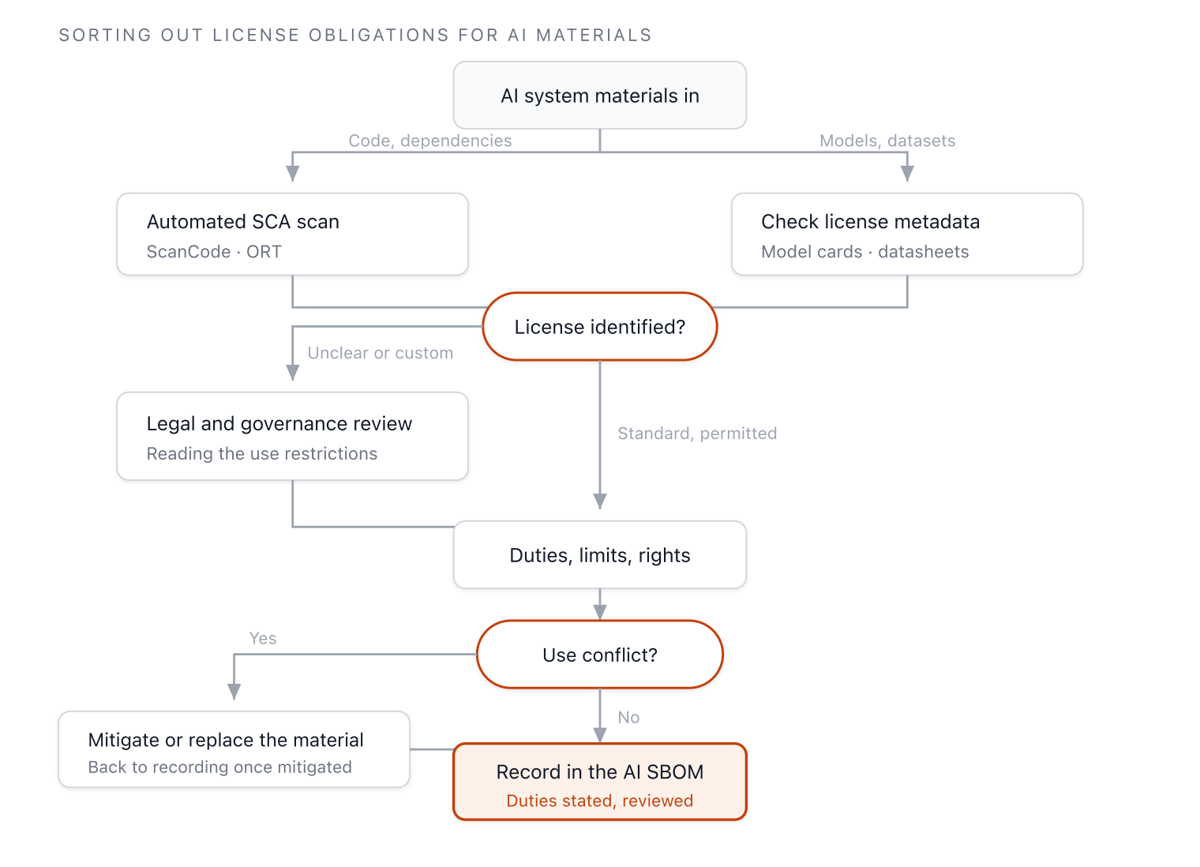
Figure 1. Decision flow for license obligation review
Considerations
- Enforce metadata at the intake gate: The largest cause of missed license obligations is
license drift — the loss of provenance and license information as a model propagates
downstream. One study reports that a substantial share of restriction clauses disappear in the
transition from model to application (arXiv:2509.09873).
Rather than trying to reconstruct this downstream, it is more effective to block the intake of
materials lacking license metadata at the internal model/dataset registry.
([Guide Recommendation])
- Decide non-standard licenses through policy in advance: The behavioral use restrictions of
the Llama Community License or the OpenRAIL family are hard to track automatically for
compliance after the fact. Decide them at intake time using the allowed/prohibited lists in
3.1 Policy. ([Guide Recommendation])
- Trace the model tree: Check the model card to see which parent model an incoming model was
derived from, and review whether the parent model’s license obligations propagate downstream.
- Check dataset usage restrictions: Check whether a non-commercial-licensed dataset such as
CC-BY-NC was used to train a commercial product. Dataset license omissions and misstatements
are common, so cross-check against the original text.
- Recognize the limits of automation: Do not treat automated scan results as the final
judgment. Tools help with identification; people handle the interpretation of obligations and
conflict determination.
Sample
Below is a sample of the core part of a license obligation review procedure document. This
procedure document becomes verification material 3.5.1.
## AI License Obligation Review Procedure

### 1. Scope of Review
- AI system code and dependencies
- Model weights (imported models, fine-tuned models)
- Datasets (training, testing, validation)
- Licenses of parent models in the model tree

### 2. Review Steps
1) Automated identification: scan code and dependencies for licenses using an SCA tool.
2) Metadata collection: collect licenses for models and datasets from model cards and
   datasheets. Hold intake if metadata is missing.
3) Classification: check identified licenses against the policy's allowed/conditional/
   prohibited lists.
4) Legal review: route non-standard or unclear licenses to legal/governance review to
   interpret the obligations.
5) Recording: record upstream and downstream obligations, restrictions, and rights in
   the AI SBOM.

### 3. Responsibility and Frequency
- Initial identification: development staff
- Interpreting obligations: legal / AI governance lead
- Re-review: when a model or dataset is replaced, and at least once a quarter
5. References
2.2 - 3.6 Transparency Obligations
Explains the procedure for reviewing transparency obligations imposed by regulation and applying risk mitigation measures to issues such as disclosure of training data.
1. Clause Overview
If license obligations (3.5) ask “do we have the right to use this material,” transparency
obligations ask “what must we disclose about this material.” The two obligations come from
different sources. License obligations are imposed by the rights holder through a contract;
transparency obligations are imposed by regulation through law.
3.6 requires having a procedure to review whether there are transparency obligations imposed by
regulation. The scope of review includes training, testing, and verification datasets, taking into
account the model’s intended use. If the use case for the training data creates a transparency
issue (e.g., a disclosure obligation to downstream recipients), appropriate risk mitigation measures
must be taken. As the EU Artificial Intelligence Act begins full enforcement of transparency
obligations from August 2026, the practical weight of this clause is growing.
2. Required Activities
- Maintain a procedure to identify the transparency regulations that apply to AI systems being
adopted or developed.
- Review whether training, testing, and verification datasets carry disclosure obligations, based
on their intended use.
- Determine risk mitigation measures where a disclosure obligation to downstream recipients exists.
- Document the transparency measures taken.
- Regularly update and reflect the latest transparency obligations set by regulators. ([Recommendation of this guide])
3. Requirements and Verification Material
| Clause | Requirement (EN) | Verification Material |
|---|
| 3.6 | A process shall exist for reviewing if there are any transparency obligations from regulations including but not limited to training, testing, and verification datasets, taking into account the intended use of the model. If the use case for the training data creates a relevant issue (e.g., disclosure obligations to downstream recipients) in the context of transparency, then appropriate risk mitigation measures should be undertaken. | 3.6.1 A documented procedure to review and document the transparency measures undertaken |
View original English text
3.6 Transparency obligations
A process shall exist for reviewing if there are any transparency obligations from regulations
including but not limited to training, testing, and verification datasets, taking into account the
intended use of the model. If the use case for the training data creates a relevant issue (e.g.,
disclosure obligations to downstream recipients) in the context of transparency, then appropriate
risk mitigation measures should be undertaken.
Verification material(s):
- A documented procedure to review and document the transparency measures undertaken.
4. Compliance Methods and Samples by Verification Material
3.6.1 Procedure to review and document transparency obligations
Compliance Method
Transparency obligations differ by regulation, so first identify which regulations apply. Once the
applicable regulations are determined, derive the disclosure items each one requires and reflect
those items in the AI SBOM or model card. Unlike license obligations, transparency obligations
center on “disclosure,” so the output must be organized in a form that can be delivered externally.
The table below lists the main transparency obligations that intersect with the AI SBOM. The
regulatory timeline and broader context are managed together in the regulatory matrix in
3.10 Governance.
Table 1. Transparency obligations that intersect with the AI SBOM (as of June 2026)
| Source | Transparency Obligation | Reflected in AI SBOM / Model Card |
|---|
| EU Artificial Intelligence Act Article 53 (GPAI) | Public summary of training data, honoring copyright opt-outs | Dataset provenance and license, opt-out handling records |
| EU Artificial Intelligence Act Article 50 | Labeling AI-generated content, notice of AI interaction | Output labeling policy |
| Korea’s AI Basic Act | Labeling obligation for high-impact and generative AI, disclosure of training data provenance | Model card labeling and provenance fields |
| License-derived notices | Notices such as “Built with Llama,” naming of derivative models | Tracked together with license obligations (3.5) |
The figure below shows the review flow that derives transparency obligations from a material’s
intended use.
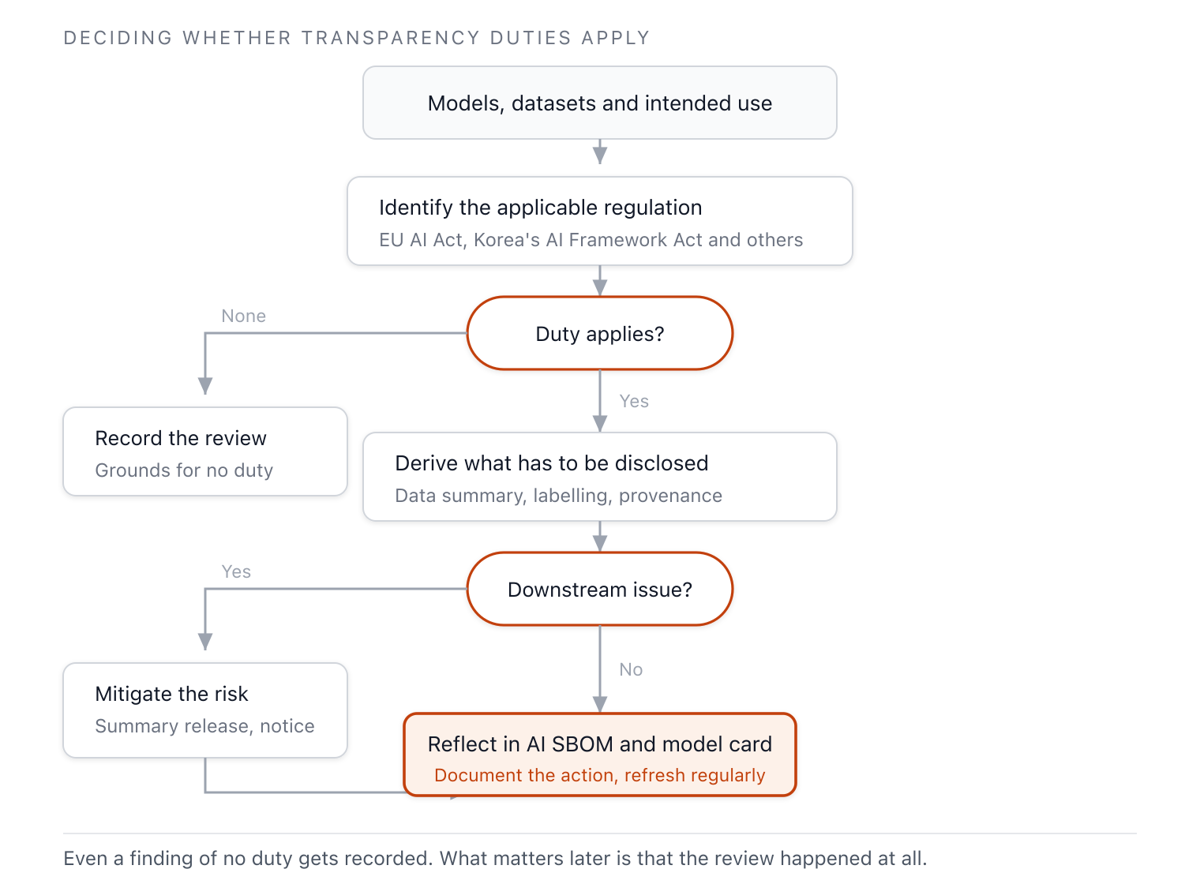
Figure 1. Transparency obligation review flow
Considerations
- Dataset provenance is central: Most transparency obligations attach to training data. A
dataset’s provenance and license must be recorded in the AI SBOM to fulfill disclosure
obligations. This connects directly to the AI SBOM (3.9).
- Intended use is the criterion: The same model can carry different transparency obligations
depending on the use case. High-risk uses or services aimed at the general public carry heavier
obligations.
- Downstream disclosure obligations: When supplying a model or system externally, review what
information the recipient must be told. Risk mitigation can be fulfilled through a public summary
of training data or contractual notice.
- Reflect regulatory change: Since the EU Artificial Intelligence Act applies transparency
obligations from August 2026, update the procedure to match the timeline. Responsibility for the
update is managed by governance (3.10).
Sample (Transparency Obligation Review Procedure)
Below is a sample of the core part of a transparency obligation review procedure document. This
procedure document becomes verification material 3.6.1.
## Transparency Obligation Review Procedure

### 1. Identify Applicable Regulations
Identify applicable regulations based on the AI system's intended use and deployment
region.
(e.g., EU market deployment → EU Artificial Intelligence Act; domestic high-impact AI →
Korea's AI Basic Act)

### 2. Derive Disclosure Items
Organize each regulation's transparency obligations into disclosure items.
- Training data summary (EU Artificial Intelligence Act Article 53)
- AI-generated / interaction labeling (EU Artificial Intelligence Act Article 50, Korea's
  AI Basic Act)
- Data provenance disclosure (Korea's AI Basic Act)

### 3. Downstream Review
Review the information to be conveyed to recipients on external supply, and determine the
necessary risk mitigation measures.

### 4. Reflection and Documentation
Reflect the derived disclosure items in the AI SBOM and model card, and record the
measures taken.

### 5. Responsibility and Cycle
- Review: Legal and AI governance lead
- Update: On changes to regulatory enforcement timelines, and at least semiannually
5. See Also
2.3 - 3.9 AI SBOM
Explains the procedure and formats for generating and managing an AI SBOM, automation tools, and the verification areas that tools alone struggle to fill.
1. Clause Overview
An AI SBOM (AI System Bill of Materials) is a list capturing the elements that make up an AI
system and the information about them. Where a traditional SBOM records software components, an
AI SBOM adds models, weights, datasets, and hyperparameters on top. 3.9 requires a procedure for
generating and managing the AI SBOM.
The format is left open. The specification states that SPDX, CycloneDX, or any other format is
acceptable. There is, however, one obligation: the AI SBOM shall account for inbound materials
from third parties. If pre-trained models and datasets brought in from outside are left out, the
basis for tracking license obligations (3.5) and transparency
obligations disappears.
The AI SBOM area is where the line “generation is automated by tools, but accuracy and compliance
judgment are filled by people” is sharpest. This page walks through the procedure along that
line.
- Establish a procedure for identifying, tracking, reviewing, approving, and archiving the
components of an AI system (models, datasets, etc.).
- Decide on an AI SBOM format (SPDX 3.0 AI Profile or CycloneDX ML-BOM recommended).
([Guide Recommendation])
- Ensure models and datasets brought in from third parties are always included in the AI SBOM.
- Wire a generation tool into CI/CD to regenerate the AI SBOM repeatedly. ([Guide Recommendation])
- Have a person review whether the license and provenance fields of the generated AI SBOM are
accurate. ([Guide Recommendation])
- Retain records (generation history, approval history) demonstrating that the procedure was
followed.
3. Requirement and Verification Material
| Clause | Requirement | Verification Material |
|---|
| 3.9 | A procedure shall exist for generating and managing an AI SBOM. Any format — SPDX, CycloneDX, or another — is acceptable. The AI SBOM shall account for inbound materials from third parties. | 3.9.1 A documented procedure for identifying, tracking, reviewing, approving, and archiving information about the components of an AI system (models, datasets, etc.)
3.9.2 Records demonstrating the procedure was properly followed for the supplied system |
View original English text
3.9 AI System Bill of Materials
A process shall exist for creating and managing an AI SBOM, this can be in any format e.g. SPDX,
CycloneDX, or another format. The AI SBOM shall account for inbound materials from third-parties.
Verification material(s):
- A documented procedure for identifying, tracking, reviewing, approving, and archiving
information related to the components of an AI system (e.g., model, datasets, etc).
- Records for the supplied system that demonstrates the documented procedure was properly followed.
4. How to Comply with Each Verification Material, with Samples
3.9.1 AI SBOM Management Procedure (Identification, Tracking, Review, Approval, Archiving)
How to Comply
Design the AI SBOM procedure around four stages: generation, review, approval, and archiving.
Automate the generation stage with tools, and leave the review and approval stages to people.
Even when a tool copies a license field straight from a model card, it cannot judge whether that
license actually fits the use case, or whether something is missing or misstated.
The figure below shows the flow from AI SBOM generation to archiving.
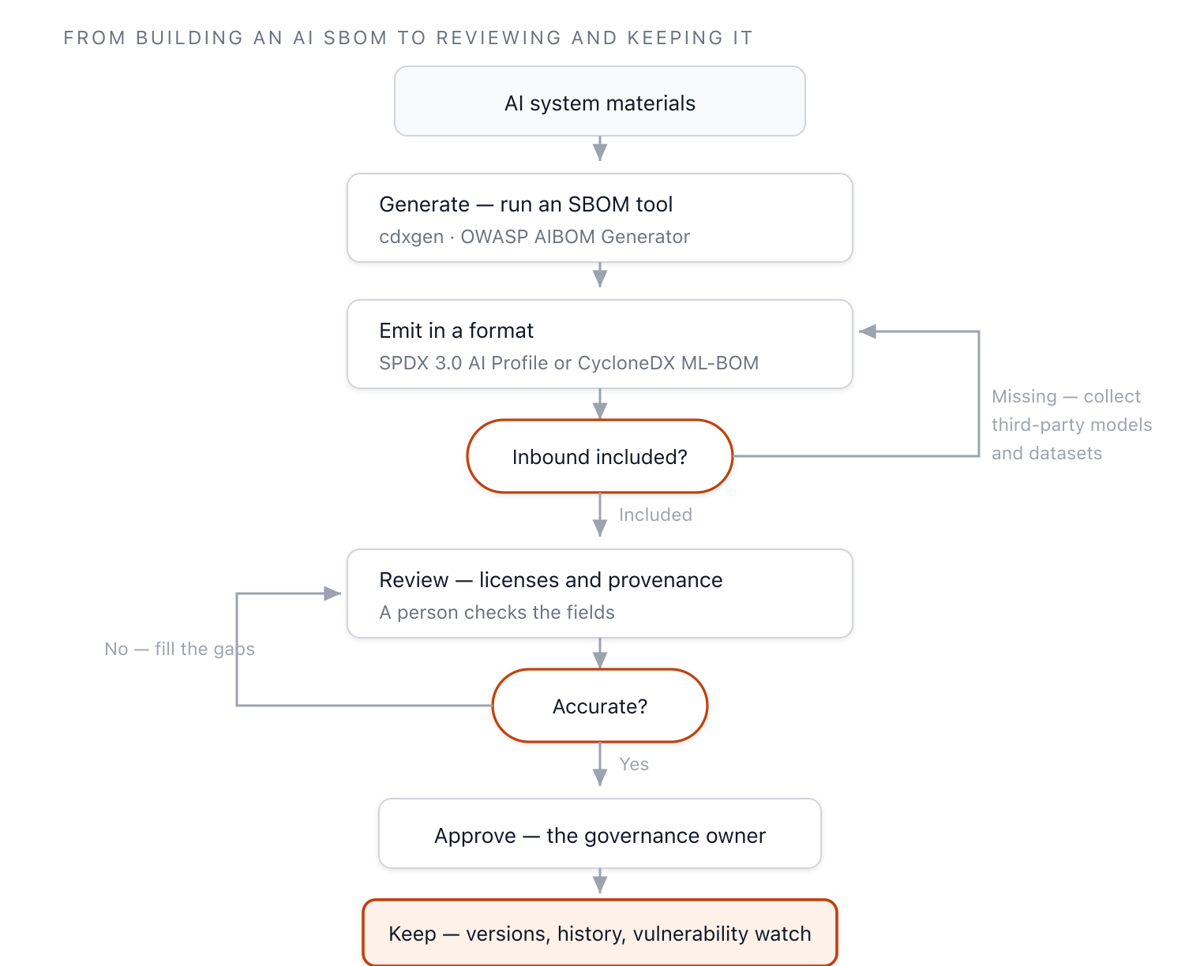
Figure 1. Procedure from AI SBOM generation to archiving
Tool Mapping
Below are open source tools usable at each stage. “Automation level” indicates how far a tool
handles that task on its own.
| Stage | Task | Automation Level | Representative Tool |
|---|
| Generation | Code/dependency BOM | Mature | cdxgen, Syft |
| Generation | Model/metadata AIBOM | Tools emerging | OWASP AIBOM Generator, cdxgen aibom |
| Analysis | Static inspection of model binaries | Tools emerging | Lab700x AI SBOM Scanner |
| Management | SBOM storage, vulnerability monitoring | Mature | Dependency-Track, SW360 |
| Review | License/provenance accuracy judgment | People/policy | Tool support still developing |
Installation, usage, and execution screens for each tool are covered in detail in the
Tools section (OWASP AIBOM
Generator, cdxgen,
Model/Container Scanners).
The command to generate an AI BOM with cdxgen is as follows. You can pass a Hugging Face model
URL and purl, a Modelfile, or a GGUF artifact directly (cdxgen AI-BOM
docs).
# Generate an AI BOM from the AI project directory
cdxgen -t ai -o aibom.json .

# Generate including AI/ML metadata (formulation)
cdxgen -t ai --include-formulation -o aibom.json .
The OWASP AIBOM Generator takes a Hugging Face model as input, builds a CycloneDX-format AIBOM,
and scores its completeness. It is maintained by the OWASP Gen AI Security Project and is also
available as a Hugging Face Space (OWASP AIBOM
Generator).
Hands-On — Generating with cdxgen
This is the result of actually running cdxgen against a summarization app (depending on
transformers and torch) that loads a pre-trained model (facebook/bart-large-cnn). The tool
automatically identifies 5 dependencies and produces a CycloneDX 1.7-format BOM.
$ cdxgen -t python --include-formulation -o aibom.json .
CycloneDX Generator 12.5.1 (Node.js)

Generated components — 5 items (CycloneDX 1.7):
  transformers     4.44.2    pkg:pypi/transformers@4.44.2      license: empty
  torch            2.4.0     pkg:pypi/torch@2.4.0             license: empty
  numpy            1.26.4    pkg:pypi/numpy@1.26.4            license: empty
  tokenizers       0.19.1    pkg:pypi/tokenizers@0.19.1       license: empty
  huggingface-hub  0.24.6    pkg:pypi/huggingface-hub@0.24.6   license: empty
One component from the generated BOM looks like this. The identification evidence is filled in,
but the licenses field is empty.
{
  "name": "transformers",
  "version": "4.44.2",
  "purl": "pkg:pypi/transformers@4.44.2",
  "type": "library",
  "evidence": {
    "identity": [
      { "field": "purl", "confidence": 0.5,
        "methods": [{ "technique": "manifest-analysis", "value": "requirements.txt" }] }
    ]
  }
}
Figure 2. cdxgen 12.5.1 execution output (run on 2026-06-13, -t python --include-formulation)
What the Execution Result Shows — Generation by Tool, Verification by People
- The tool automatically identified 5 dependencies from
requirements.txt and built a BOM.
Generation is automated. - But the
licenses field of every component is empty. License accuracy has to be checked and
filled in by a person. - The pre-trained model
facebook/bart-large-cnn the app loads was not captured in the BOM by
code scanning alone. It has to be collected separately as an inbound material and added (see
Considerations below).
The boundary this clause states — “generation by tool, accuracy and completeness by people” —
shows up directly in the actual tool output here.
Format Sample (CycloneDX ML-BOM)
Below is a shortened example of the model component structure in a CycloneDX 1.6 ML-BOM. The key
structure follows the machine-learning-model component and modelCard in the official
CycloneDX spec. If the license is non-standard (has
no SPDX ID), state it with name.
{
  "bomFormat": "CycloneDX",
  "specVersion": "1.6",
  "components": [
    {
      "bom-ref": "model-llama31-8b",
      "type": "machine-learning-model",
      "group": "meta-llama",
      "name": "Llama-3.1-8B",
      "version": "1.0",
      "licenses": [
        { "license": { "name": "Llama 3.1 Community License" } }
      ],
      "modelCard": {
        "modelParameters": {
          "task": "text-generation",
          "architectureFamily": "llama",
          "datasets": [
            { "type": "dataset", "name": "Public pretraining corpus", "classification": "public" }
          ]
        },
        "considerations": {
          "useCases": ["Internal document summarization"],
          "technicalLimitations": ["Potential for hallucination", "Performance variance in Korean"]
        }
      }
    }
  ]
}
If you use SPDX 3.0, the AI Profile and Dataset Profile express the same information (SPDX 3.0 AI
Profile). The concrete fields of each
format and the technical details of generation tools are covered in the ISO/IEC 42001 Guide — AI
SBOM.
Considerations
- Reflect inbound materials (specification obligation): Set up a procedure that generates an
SBOM entry at intake time so that models and datasets brought in from outside are never missing
from the AI SBOM. This is a
shall-level obligation. - Generation by tool, review by people: Generation tools copy the license written on the
model card as-is. Because model cards themselves commonly have missing or incorrect license
information, have a person check the license and provenance fields of the generated AI SBOM
against the original source.
- Format consistency: Pick either SPDX or CycloneDX as the organization’s default format and
operate tools and repositories around it consistently. Both formats treat models and datasets
as first-class components.
- CI/CD integration: The AI SBOM is not a one-time deliverable. Wire it into the pipeline so
it is regenerated whenever a model or dataset changes.
3.9.2 Records Demonstrating Procedure Compliance
How to Comply
Verification material 3.9.2 is the record showing the procedure was actually followed. Alongside
the AI SBOM file itself, keep a history of who generated, reviewed, and approved it and when. If
it is generated automatically in CI/CD, the build logs and the generated SBOM artifact become the
record, and the upload history to a management tool such as Dependency-Track also serves as
evidence.
Considerations
- Retain generation history: Keep the AI SBOM from each point in time for every version of
the supplied AI system to maintain traceability.
- Approval record: Record who reviewed and approved it. This connects to the lifecycle review
in Governance (3.10).
5. References
3 - Operations
The stage of establishing a channel to respond to external compliance inquiries and assigning responsibility and resources to the program.
This is stage 3 of the implementation roadmap. It establishes a channel to respond to external AI SBOM
compliance inquiries (3.7) and assigns responsibility, personnel, and funding to the program (3.8).
3.1 - 3.7 Access
Explains how to publicly identify a means for third parties to make AI SBOM compliance inquiries and the internal procedure for responding to them.
1. Clause Overview
Organizations that exchange AI systems in the supply chain need to verify each other’s compliance.
That requires a publicly available channel for external inquiries, and readiness on the
organization’s side to respond to them. Access secures both directions.
3.7 requires two things: publicly identifying a means by which a third party can make an AI SBOM
compliance inquiry, and maintaining an internal procedure to respond effectively to that inquiry.
In AI, AI-specific information — model and dataset licenses, training data provenance, model cards —
is added to the subject matter of such inquiries.
2. Required Activities
- Publicly identify a means (e.g., a public email address) by which a third party can make an AI
SBOM compliance inquiry.
- Post the public means somewhere externally discoverable, such as a product notice or website.
- Document the internal procedure for receiving, classifying, and responding to external inquiries.
- Define the responsible party and the response deadline.
- Record the history of inquiries and responses.
3. Requirements and Verification Material
| Clause | Requirement (EN) | Verification Material |
|---|
| 3.7 | Maintain a process to effectively respond to external AI SBOM Compliance inquiries. Publicly identify a means by which a third party can make an AI SBOM Compliance inquiry. | 3.7.1 Publicly visible method that allows any interested parties to make an AI SBOM Compliance inquiry (e.g., via a published contact email address)
3.7.2 An internal documented procedure for responding to third-party AI SBOM Compliance inquiries |
View original English text
3.7 Access
Maintain a process to effectively respond to external AI SBOM Compliance inquiries. Publicly
identify a means by which a third party can make an AI SBOM Compliance inquiry.
Verification material(s):
- Publicly visible method that allows any interested parties to make an AI SBOM Compliance inquiry
(e.g., via a published contact email address).
- An internal documented procedure for responding to third-party AI SBOM Compliance inquiries.
4. Compliance Methods and Samples by Verification Material
3.7.1 Publicly identified means of external inquiry
Compliance Method
Identify a public contact means that anyone can find. A role-based email address (a job function
address, not an individual) is stable. Post it in locations such as the product notice, the open
source/AI policy page on the company website, or the contact field of the model card. Stating a
response deadline alongside it builds trust.
Sample
AI Compliance Inquiries: ai-compliance@company.com

We accept inquiries regarding the components of the AI systems we provide, model and
dataset licenses, and AI SBOMs. We send an initial reply within 14 business days of
receipt.

(Posted at: product notice, company website AI policy page, model card contact field)
3.7.2 Internal inquiry response procedure
Compliance Method
Document the internal procedure from receiving an external inquiry to answering it. Define the
stages of intake, classification, assignment, review, reply, and recording, with a deadline for
each stage. Because AI SBOM inquiries need to reference model cards or license review records, the
AI SBOM verification lead and the license review lead respond together.
The figure below shows the external inquiry response flow.
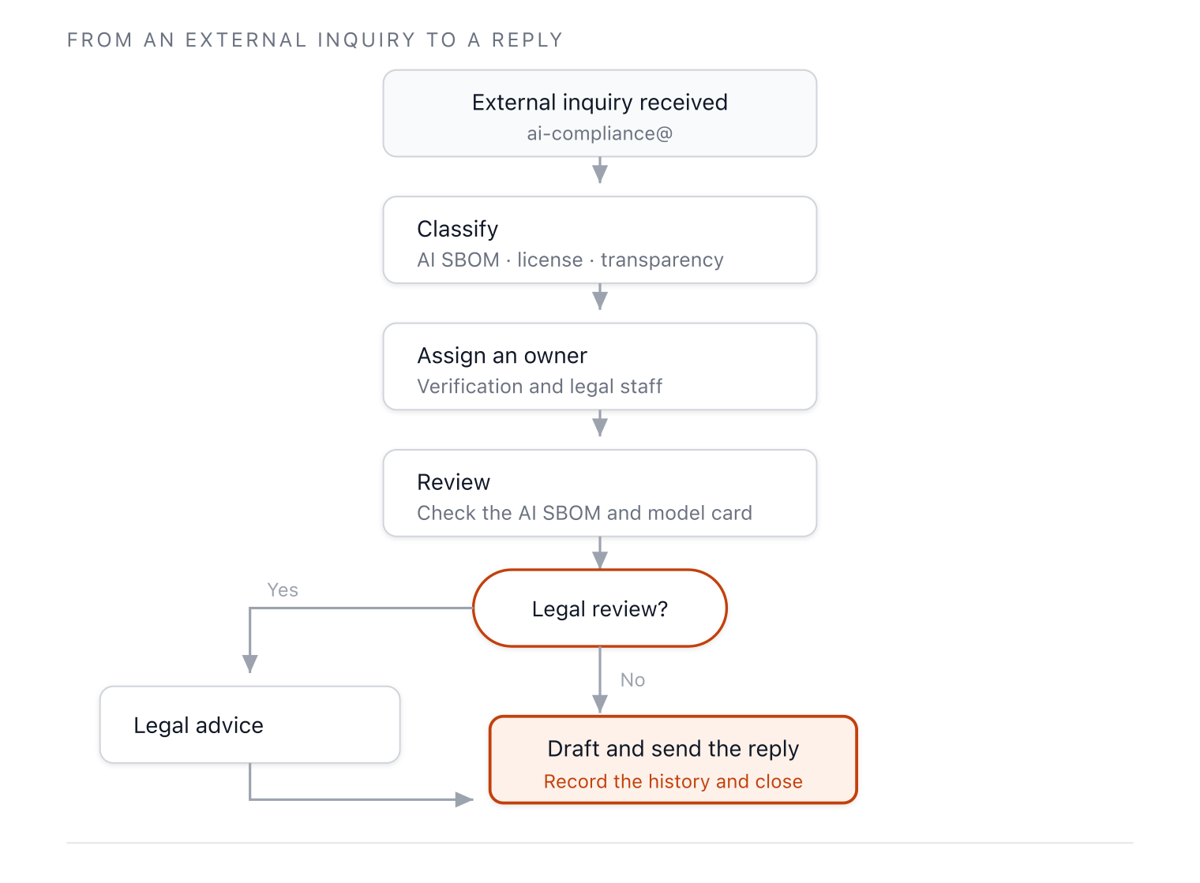
Figure 1. External AI SBOM compliance inquiry response flow
Considerations
- Set deadlines: Define both an initial reply deadline (e.g., 14 days) and a final answer
deadline (e.g., 60 days).
- Protect AI-specific information: Set a standard for how far to disclose sensitive information
such as model weights or training data when answering inquiries. Define the boundary between
trade secrets and transparency obligations (3.6). ([Recommendation of this guide])
- Retain history: Record the inquiry content, the reply, and the processing time as verification
material.
Sample (Response Procedure Outline)
## AI SBOM Compliance Inquiry Response Procedure

1. Intake: Register inquiries received at ai-compliance@.
2. Classification: Classify as AI SBOM request / license inquiry / transparency
   obligation inquiry.
3. Assignment: Assign to the AI SBOM verification lead or the license review lead based
   on classification.
4. Review and Reply: Reply after checking the relevant AI SBOM and model card. Follow the
   disclosure standard for sensitive information. Involve legal review if needed.
5. Record: Retain the inquiry, reply, and processing time.

Deadlines: 14 days for the initial reply, 60 days for the final answer.
5. See Also
3.2 - 3.8 Effectively Resourced
Explains how to assign responsibility, staffing, funding, and legal expertise to an AI SBOM compliance program, and how to remediate non-conformances.
1. Clause Overview
If competence (3.2) defines who should be able to do what, effective resourcing is what actually
attaches people, time, and budget to those roles so the program runs. When policy and procedures
exist only on paper and no resources back them, compliance is a name only.
3.8 requires assigning accountability for program tasks and allocating adequate resources. There
are five verification materials, covering the naming of role holders, the provision of staffing
and funding, access to legal expertise, an internal responsibility-assignment procedure, and a
non-conformance remediation procedure. The specification references the resource-related sections
of ISO/IEC 42001 Annex B (B.4.2, B.4.6) and the human oversight determination section (B.9.3).
- Assign accountability for the successful execution of program tasks.
- Allocate sufficient time and funding to the tasks.
- Make legal expertise on AI SBOM compliance accessible to those who need it.
- Have a procedure for reviewing and updating the policy and its supporting tasks.
- Have a procedure for reviewing and remediating non-conformances.
3. Requirement and Verification Material
| Clause | Requirement | Verification Material |
|---|
| 3.8 | The organization shall assign accountability for program tasks, allocate sufficient time and funding, and have access to legal expertise and a non-conformance remediation procedure. | 3.8.1 A document identifying the persons, groups, or functions holding program roles
3.8.2 Evidence that identified roles have been staffed and adequately funded
3.8.3 Identification of expertise (internal or external) available to handle AI SBOM compliance matters
3.8.4 A documented procedure for assigning internal responsibility for AI SBOM compliance
3.8.5 A documented procedure for handling the review and remediation of non-conformances |
View original English text
3.8 Effectively resourced
Identify and Resource Program Task(s): assign accountability to ensure the successful execution of
program tasks; program tasks are sufficiently resourced (time and adequate funding allocated); a
process exists for reviewing and updating the policy and supporting tasks; legal expertise
pertaining to AI SBOM Compliance is accessible to those who may need such guidance; and a process
exists for the resolution of AI SBOM Compliance issues.
Verification material(s):
- Document with name of persons, group or function in program role(s) identified.
- The identified program roles have been properly staffed and adequate funding provided.
- Identification of expertise available to address AI SBOM Compliance matters which could be
internal or external.
- A documented procedure that assigns internal responsibilities for AI SBOM Compliance.
- A documented procedure for handling the review and remediation of non-compliant cases.
See, e.g., Sections B.4.2 and B.4.6 of Annex B of ISO/IEC 42001. Section B.9.3 also provides
guidance to determine if human resources for human oversight should be incorporated.
4. How to Comply with Each Verification Material, with Samples
3.8.1 Document Identifying Role Holders
How to Comply
Document, by name, the people, groups, or functions holding program roles. Including the job
title alongside the name is more stable against personnel changes. The AI SBOM program needs, in
addition to the usual open source roles, an AI governance lead, an AI SBOM verification owner,
and a model/dataset license review owner.
Sample
| Role | Holder (Job Title) | Contact |
|------|-------------|--------|
| AI Governance Lead | Kim, OO (AI Ethics & Governance Lead) | ai-gov@company.com |
| AI SBOM Verification Owner | Lee, OO (Platform Engineer) | sbom@company.com |
| License Review Owner | Park, OO (Open Source Legal) | oss-legal@company.com |
| Security Owner | Choi, OO (Product Security) | psirt@company.com |
3.8.2 Staffing and Funding
How to Comply
Show that identified roles are actually staffed and that budget has been allocated. Record the
time allocation (e.g., 30%) and the basis for the annual budget. AI SBOM compliance takes time for
model/dataset review and tool operation, so estimate the per-role time allocation realistically.
Considerations
- State the time allocation: For a shared role, record the percentage of time allocated to AI
SBOM work.
- Tool budget: Include the cost of AI SBOM generation/management tools and legal counsel in
the budget.
Sample
| Role | Holder | Time Allocation | Annual Budget Basis | Approver / Approval Date |
|------|--------|----------|---------------|--------------|
| AI Governance Lead | Kim, OO | 30% | Personnel cost + regulatory counsel | CTO / 2026-01-15 |
| AI SBOM Verification Owner | Lee, OO | 50% | Personnel cost + tool operation | CTO / 2026-01-15 |
3.8.3 Access to Legal Expertise
How to Comply
Make legal expertise on AI SBOM compliance accessible to those who need it. Because interpreting
non-standard licenses and determining regulatory obligations is legal’s job, specify the access
path — internal legal counsel or an outside firm. Also define escalation criteria (which matters
get escalated to legal).
Sample
- Internal: Open Source Legal Owner (Park, OO) — first-pass license review
- External: XX Law Firm, AI/IP team — non-standard license disputes, regulatory interpretation
- Escalation criteria: a license not on the policy's prohibited/conditional lists, determining
  downstream disclosure obligations, matters where new regulation newly applies
3.8.4 Internal Responsibility Assignment Procedure
How to Comply
Document the procedure for assigning internal responsibility for AI SBOM compliance. Vague
responsibility leads to gaps, so a RACI matrix distinguishing Responsible (R), Accountable (A),
Consulted (C), and Informed (I) per task is effective.
Sample (RACI Matrix)
| Task | AI Governance Lead | AI SBOM Verification Owner | License Review Owner | Security Owner |
|---|
| AI SBOM generation | I | R | C | I |
| License obligation review | A | C | R | I |
| Transparency obligation review | A | C | R | I |
| Vulnerability monitoring | I | C | I | R |
| Periodic framework review | R/A | C | C | C |
R Responsible, A Accountable, C Consulted, I Informed
How to Comply
Have a procedure for reviewing and remediating non-conformances (e.g., a prohibited-license model
brought in, a missing AI SBOM, a failure to meet transparency obligations). Vary the handling
deadline by severity. In AI, a licensing problem sometimes surfaces after a model has already been
deployed, so prepare a remediation path that includes recall or replacement.
Sample (Remediation Procedure and Severity Criteria)
Remediation procedure: identify/report → assess severity → root-cause analysis → corrective
action → recurrence prevention → record

| Severity | Example | Handling Deadline |
|--------|------|----------|
| High | A prohibited-license model is included in a product shipped externally | Immediate response (contain/replace review within 48 hours) |
| Medium | An inbound model is missing from the AI SBOM | Backfill within 7 days |
| Low | Some model card metadata is missing | Handle at the next periodic review |
5. References
4 - Governance
The stage of establishing a governance framework across the full AI system lifecycle and reflecting emerging AI regulations.
This is stage 4 of the implementation roadmap. It brings the preceding clauses together to establish a
governance framework across the full AI system lifecycle, and reviews it regularly to reflect emerging AI
regulations (3.10).
4.1 - 3.10 Governance
Explains how to establish a governance framework spanning the full AI system lifecycle and review it periodically to reflect emerging AI regulation.
1. Clause Overview
Governance is the framework that ties all the preceding clauses together to ensure the AI
system’s lifecycle is developed, deployed, and managed responsibly from end to end. Where policy
(3.1) sets the principles and license obligations (3.5) and the AI SBOM (3.9) build individual
processes, governance manages these so they keep operating consistently through regulatory change
and model replacement.
3.10 requires an AI governance framework, policies, and practices. The specification emphasizes
compliance with emerging AI laws such as the EU AI Act, the Hiroshima AI Process, and China’s
Global AI Governance Initiative, and addresses ethical considerations, risk management, and
transparency together. The core is to review a framework, once built, periodically so it reflects
the latest regulation and model changes.
- Write a governance framework document that spans the full AI system lifecycle.
- Include emerging AI regulation tracking, risk management, transparency, and ethical
considerations in the framework.
- Have a procedure for periodically reviewing and updating the framework.
- Monitor the risks that come with the ongoing use of AI systems and training data.
- Reflect events such as model tree changes, regulatory enforcement, and OSAID classification
changes in governance. ([Guide Recommendation])
3. Requirement and Verification Material
| Clause | Requirement | Verification Material |
|---|
| 3.10 | The organization shall have an AI governance framework, policies, and practices that help ensure AI systems are developed, deployed, and managed responsibly. This shall emphasize compliance with emerging AI laws (the EU AI Act, the Hiroshima AI Process, China’s initiative) and address ethical considerations, risk management, and transparency. | 3.10.1 A documented AI governance framework for the AI system lifecycle, including a procedure for periodically reviewing the framework |
View original English text
3.10 Governance
An organization shall have a governance framework for AI, policies, and practices to help ensure
that AI systems are developed, deployed, and managed responsibly. Governance emphasizes compliance
with emerging AI laws and regulations, such as the EU AI Act, Hiroshima AI process or Global AI
Governance Initiative (China), and addresses ethical considerations, risk management, and
transparency. For example, understand the risks associated with ongoing use of AI Systems and
training data in the context of their intended Programs. This could include the ability to monitor
the lifecycle of the AI system and perform ongoing analysis of its intended uses.
Verification material(s):
- A documented AI governance framework for the lifecycle of an AI system with a process to review
the framework periodically.
4. How to Comply with Each Verification Material, with Samples
3.10.1 AI Governance Framework and Periodic Review Procedure
How to Comply
The governance framework covers three things: tracking emerging regulation to derive obligations,
monitoring the AI system lifecycle, and a procedure for periodically reviewing the framework
itself. Because regulation changes quickly, the framework must be a living system built for
updates, not a fixed document.
The three axes the specification names differ in character. The EU AI Act imposes concrete,
article-level obligations; the Hiroshima AI Process runs voluntary transparency reporting; and
China’s initiative is closer to a policy declaration. Governance distinguishes these differences
and tracks each accordingly.
The table below lists the major regulations to track from an AI SBOM perspective. The full
regulatory matrix and its ISO/IEC 42001 context are covered in ISO/IEC 42001 Guide —
Organizational Context and
Leadership.
Table 1. Major AI regulations intersecting with AI SBOM (as of 2026-06)
| Regulation/Initiative | Timing | Core AI SBOM-Relevant Obligation | Governance Reflection |
|---|
| EU AI Act Article 11 + Annex IV | 2027 (high-risk) | Technical documentation obligation | Produce the AI SBOM as a core element of the technical documentation |
| EU AI Act Article 53 (GPAI) | 2026-08 | Disclosure of a training data summary, respecting copyright opt-outs | Track dataset provenance and licensing |
| EU AI Act Article 50 | 2026-08 | Labeling of AI-generated content | Links to the transparency obligation (3.6) |
| Hiroshima AI Process | Launched 2025, Reporting 2.0 (2026-05) | Voluntary transparency reporting | Consider participating in the OECD reporting framework |
| China’s Global AI Governance Initiative | Announced 2023 | Policy declaration (no concrete deliverable) | Monitor trends |
| Korea’s AI Basic Act | Effective 2026-01 | High-impact AI impact assessment, labeling obligation, disclosure of training data provenance | AI SBOM and model card production |
Lifecycle monitoring means placing governance checkpoints along the flow from development to
retirement. The figure below shows lifecycle governance built around the AI SBOM.
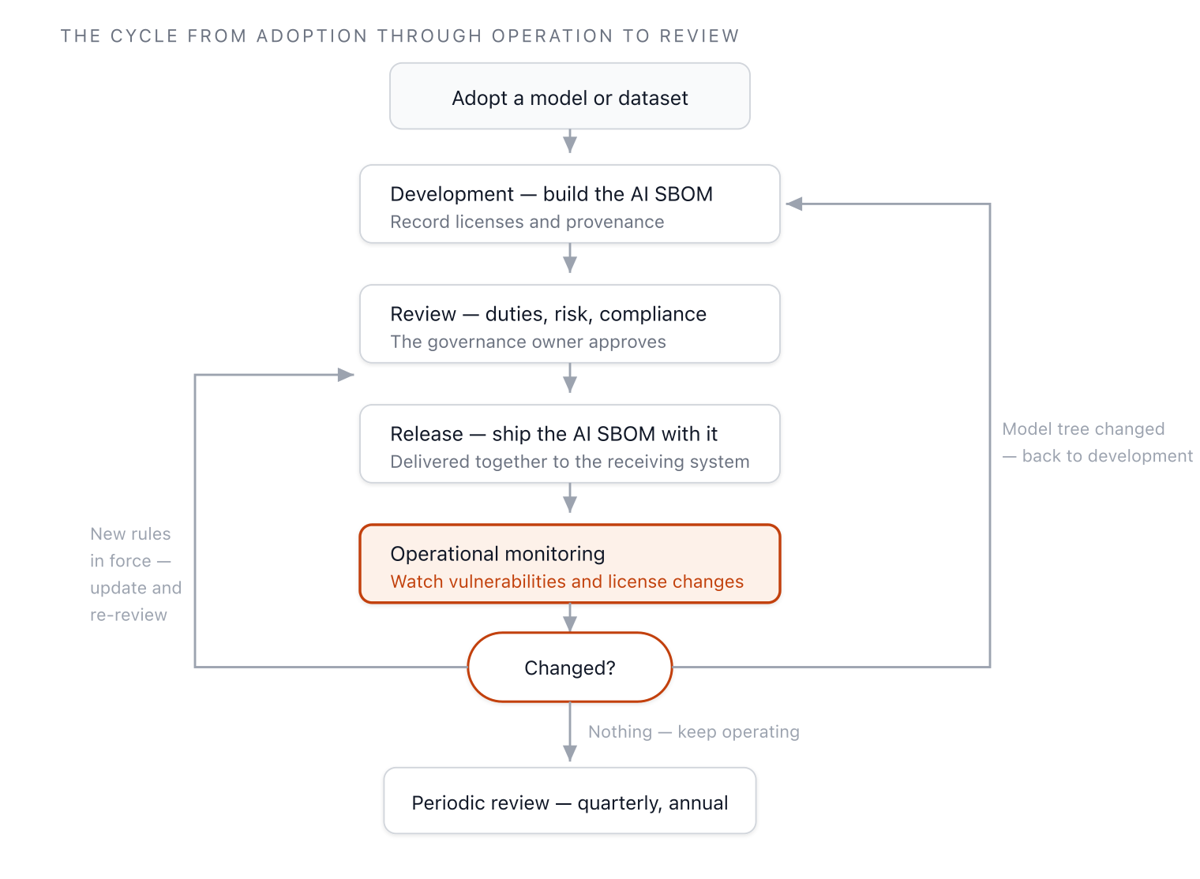
Figure 1. Lifecycle governance built around the AI SBOM
Considerations
- Assign regulatory-tracking responsibility: Specify in governance who tracks emerging
regulation and derives obligations from it. The EU AI Act’s obligations expand in stages in
August 2026 and 2027, so manage the timing.
- Manage model tree changes: When an imported model moves to a new version or a parent model
is replaced, license obligations can change. Register the change as a governance review event.
([Guide Recommendation])
- Update OSAID classification: The distinction between “open source AI” and “open weight”
(OSAID 1.0) affects model licensing judgments. Include classification changes in the periodic
review.
- State the review cycle: Review model and dataset changes quarterly, and regulation and the
overall framework annually. Record the review completion date and reviewer.
- Connect to other clauses: Governance ties together the regulatory review under the
transparency obligation (3.6) and the lifecycle management under the AI SBOM (3.9) from above.
Connect them rather than building duplicate procedures.
Sample (Governance Framework and Annual Review Plan)
Below is a sample of the core part of a governance framework document and periodic review plan.
This document becomes verification material 3.10.1.
## AI Governance Framework

### 1. Scope and Purpose
Manages licensing, transparency, risk, and regulatory compliance across the full
lifecycle of an AI system — intake, development, deployment, operation, and
retirement.

### 2. Governance Structure
- AI Governance Lead: approves the framework, makes the final call on regulatory obligations
- Regulatory Tracking Owner: monitors emerging AI regulation, derives obligations
- AI SBOM Verification Owner: runs the generation, review, and approval procedure
- Legal: interprets non-standard licenses and regulation

### 3. Periodic Review Plan
| Frequency | Review Item | Owner | Deliverable |
|------|----------|------|--------|
| Quarterly | Model/dataset changes, model tree licensing | AI SBOM Verification Owner | Change review record |
| Semiannual | Non-standard license classification, OSAID updates | Legal | Updated classification |
| Annual | Regulatory enforcement schedule, overall framework, policy alignment | AI Governance Lead | Revised framework |

### 4. Change Management
When a model tree change, new regulation taking effect, or a license policy change
occurs, convene an ad hoc review rather than waiting for the periodic review. Record
the review outcome and action taken in the change history.
5. References
5 - Tools
Introduces the key features and usage of open source tools that generate and analyze AI SBOMs, with actual execution screens.
This section covers open source tools that automate AI SBOM compliance. It summarizes each tool’s key
features, installation, and usage together with actual execution results. This elaborates, tool by tool, on
the categories seen in the automation maturity map in 3.9 AI SBOM.
There is a boundary worth stating honestly. Tools generate a BOM automatically, but they cannot guarantee
that the license information in the generated BOM is accurate or that no components are missing. In the tool
comparison below, OWASP AIBOM Generator fills in license information from model cards, while cdxgen quickly
identifies dependencies but leaves the license field empty. Look at this difference when choosing a tool.
| Tool | Input | Output | Strengths | Covered In |
|---|
| OWASP AIBOM Generator | Hugging Face model ID | CycloneDX 1.6/1.7 | Model card and license metadata, completeness score | Go to section |
| cdxgen | Project directory, model files | CycloneDX | Automatic dependency identification, CI/CD integration | Go to section |
| Lab700x, Trivy, Syft | Model binaries, containers, virtual environments | Reports, SBOM | Static model analysis, inference server and package identification | Go to section |
Each tool automates part of the generation, analysis, or management stage. No single tool solves everything,
so combine tools that generate AI SBOMs (OWASP AIBOM Generator, cdxgen) with tools that analyze security
(Lab700x, Trivy) and a tool that manages them
(Dependency-Track).
5.1 - OWASP AIBOM Generator
Explains how to use the OWASP tool that generates a CycloneDX-format AI SBOM from a Hugging Face model and scores its completeness, together with actual execution screens.
Overview
OWASP AIBOM Generator is an open source tool that takes a Hugging Face model ID as input, fetches
model card metadata, and generates an AI SBOM in CycloneDX format. It is maintained by the OWASP
Gen AI Security Project, and its distinguishing feature is scoring how complete the generated BOM is.
Where cdxgen identifies dependencies quickly but leaves the license fields empty, this tool fills in
the license, author, and external references recorded in the model card. It works well as a
starting point for the license review required by
3.5 License Obligations.
Key Features
- Fetches metadata from Hugging Face models and generates an AIBOM in both CycloneDX 1.6 and 1.7
format.
- Evaluates the completeness of the generated BOM with a score (0–100) and a profile, broken down
section by section.
- Displays model information, the model card, license, and external references in a human-readable
view.
- Available both as a web UI and a command-line interface (CLI).
Usage A — Web UI
The simplest approach: just enter a model ID in the browser. Use the Hugging Face Space provided by
the OWASP Gen AI Security Project, or clone the repository and run it locally.
First, enter a Hugging Face model ID (e.g., facebook/bart-large-cnn) on the input screen and click
generate.
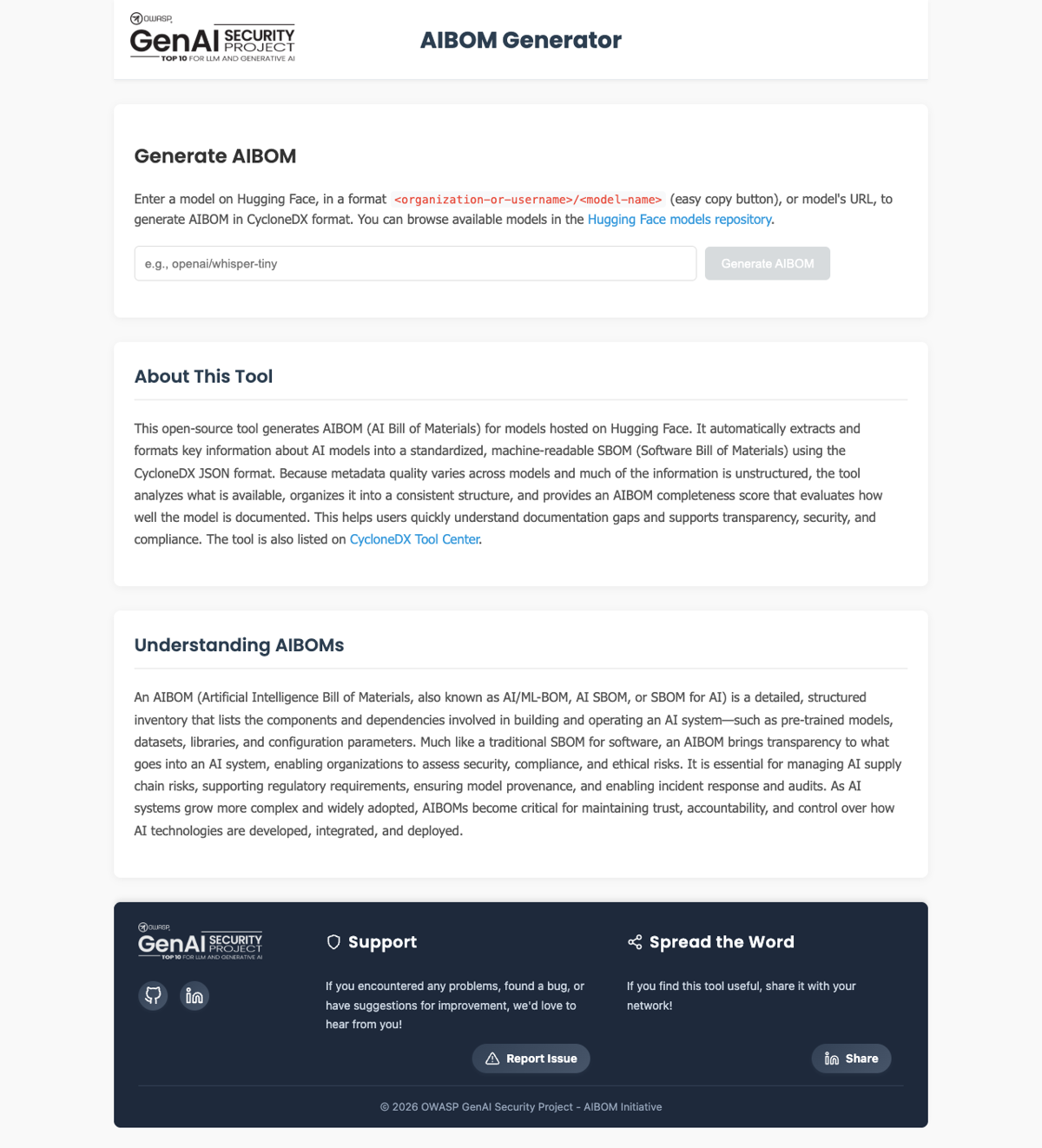
Figure 1. OWASP AIBOM Generator input screen (GenAI Security Project, captured 2026-06-13)
Once generation finishes, the result screen shows an AIBOM summary, the completeness assessment,
download buttons (CycloneDX 1.6 and 1.7), AI model information, and the model card. The completeness
assessment at the top of the screen shows at a glance whether the BOM has the minimum fields needed
for identification.
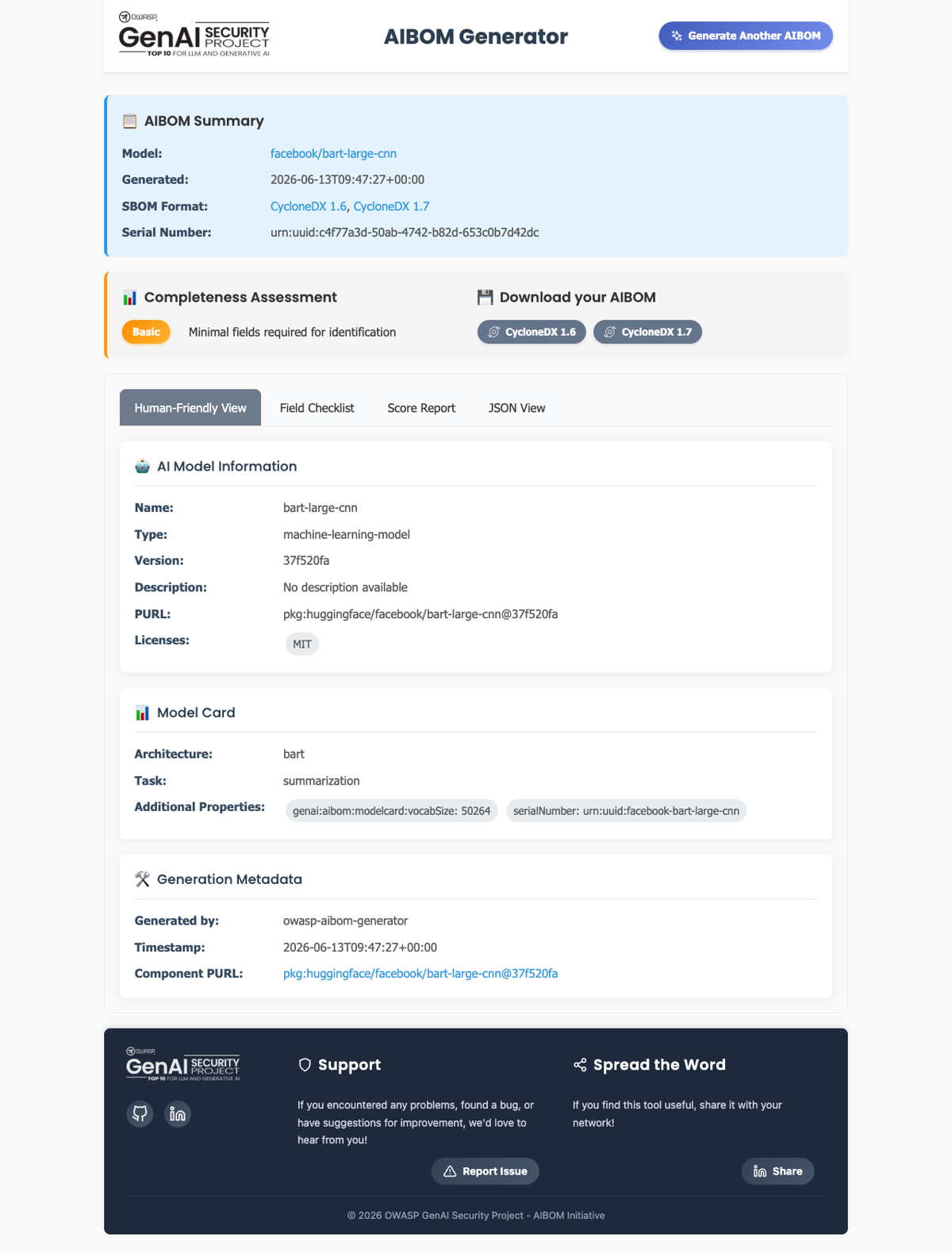
Figure 2. Generation result screen — model information, license (MIT), completeness assessment
(Basic) (captured 2026-06-13)
The result screen offers a Human-Friendly View along with a field checklist, a score report, and a
JSON view tab. Check the items needed for license obligation review and AI SBOM retention directly
on screen, and download the CycloneDX file.
Usage B — Command Line (CLI)
The CLI is convenient for embedding in CI/CD or batch-processing multiple models. After
installation, pass the model ID as an argument.
# Install (a Python virtual environment is recommended)
pip install "git+https://github.com/GenAI-Security-Project/aibom-generator"

# Generate an AIBOM from a model ID
aibom facebook/bart-large-cnn -o aibom.json
Below is the actual execution result. It generates CycloneDX 1.6 and 1.7, passes schema
validation, and shows the completeness score broken down by section.
$ aibom facebook/bart-large-cnn -o aibom.json

✅ Successfully generated CycloneDX 1.6 SBOM — Schema Validation (1.6): Valid
✅ Successfully generated CycloneDX 1.7 SBOM — Schema Validation (1.7): Valid

📊 Completeness Score: 58.7/100   Profile: Basic
   - Required Fields:        20/20
   - Metadata:                8/20
   - Component Basic:        17.1/20
   - Component Model Card:    6.7/30
   - External References:    10/10
Figure 3. CLI execution output (aibom CLI, model facebook/bart-large-cnn, run 2026-06-13)
The model component in the generated BOM has its license and model card filled in. Unlike cdxgen’s
output, the licenses field is not empty.
{
  "type": "machine-learning-model",
  "name": "bart-large-cnn",
  "purl": "pkg:huggingface/facebook/bart-large-cnn",
  "licenses": [{ "license": { "id": "MIT" } }],
  "authors": [{ "name": "facebook" }],
  "modelCard": { "modelParameters": { }, "considerations": { } }
}
What the Execution Result Shows
The completeness score depends on the quality of the input metadata
In the actual run, the completeness score was 58.7/100 (Basic). Required Fields and External
References scored full marks, but the model card score was low at 6.7/30. This is not a limitation
of the tool but a result of the model provider not filling in enough information in the Hugging
Face model card. The tool faithfully fetches whatever metadata exists, but it cannot invent
information that isn’t there. When the model card is sparse, a human must verify the source and
supplement it.
See Also
5.2 - cdxgen
Explains how to use the AI BOM mode of OWASP cdxgen, which generates a CycloneDX SBOM from projects and models, together with actual execution output.
Overview
cdxgen is the official SBOM generator of the OWASP CycloneDX project. It supports more than 20
languages and package managers, and the latest version offers a dedicated AI BOM mode. It
automatically identifies the dependencies of AI applications (PyTorch, Transformers, and so on) and
integrates well with CI/CD pipelines.
From an AI SBOM standpoint, cdxgen’s strength is speed and automation. Its weakness is that it does
not fill in license information in a default run. This trait shows up in the execution result below.
Where OWASP AIBOM Generator centers on model card metadata, cdxgen centers on code and dependencies.
Using both together covers both models and dependencies.
Key Features
- Identifies dependencies from source code and container images to generate a CycloneDX SBOM.
- Includes AI/ML metadata (formulation) with AI BOM mode (
-t ai). - Takes Hugging Face model URLs, Modelfiles, and GGUF artifacts directly as input.
- Automatically submits SBOMs to a Dependency-Track server for continuous management.
Installation
# One-off run (requires Node.js)
npx @cyclonedx/cdxgen@latest --version

# Global install
npm install -g @cyclonedx/cdxgen
Usage — Generating an AI BOM
Run in AI BOM mode from the AI project directory.
# Generate an AI BOM
cdxgen -t ai -o aibom.json .

# Generate including AI/ML metadata (formulation)
cdxgen -t ai --include-formulation -o aibom.json .
Below is the actual result of running cdxgen against a summarization app (transformers, torch
dependencies) that loads a pretrained model (facebook/bart-large-cnn). It automatically identifies
5 dependencies and produces a CycloneDX 1.7 BOM.
$ cdxgen -t python --include-formulation -o aibom.json .
CycloneDX Generator 12.5.1 (Node.js)

Generated components — 5 entries (CycloneDX 1.7):
  transformers     4.44.2    pkg:pypi/transformers@4.44.2      license: empty
  torch            2.4.0     pkg:pypi/torch@2.4.0             license: empty
  numpy            1.26.4    pkg:pypi/numpy@1.26.4            license: empty
  tokenizers       0.19.1    pkg:pypi/tokenizers@0.19.1       license: empty
  huggingface-hub  0.24.6    pkg:pypi/huggingface-hub@0.24.6   license: empty
Figure 1. cdxgen execution output (cdxgen 12.5.1, run 2026-06-13)
One of the generated components looks like this. The identification evidence is filled in, but the
licenses field is empty.
{
  "name": "transformers",
  "version": "4.44.2",
  "purl": "pkg:pypi/transformers@4.44.2",
  "type": "library",
  "evidence": {
    "identity": [
      { "field": "purl", "confidence": 0.5,
        "methods": [{ "technique": "manifest-analysis", "value": "requirements.txt" }] }
    ]
  }
}
What the Execution Result Shows
cdxgen identifies quickly, but a human must fill in the license
cdxgen quickly identified 5 dependencies from requirements.txt, but the licenses field of each
component is empty. Also, the pretrained model facebook/bart-large-cnn that the app loads was not
captured in the BOM by code scanning alone. It must be collected separately as inbound material and
added. A realistic combination is to build the dependency skeleton quickly with cdxgen, have a human
verify and fill in the licenses, and generate the model separately with OWASP AIBOM Generator before
merging.
See Also
5.3 - Model and Container Scanners (Lab700x, Trivy, Syft)
Introduces the key features and usage of security scanners that analyze AI model binaries, inference servers, and AI packages.
This page introduces analysis and identification tools that complement AI SBOM generation. Where
the generation tools (OWASP AIBOM Generator, cdxgen) record “what is in it,” these tools look at
“whether it is safe” and “what version it is.” The commands and features below are organized based
on each tool’s official documentation (the tools actually run in this guide are
OWASP AIBOM Generator and cdxgen).
Lab700x AI SBOM Scanner — Static Analysis of Model Binaries
A tool that statically analyzes AI model files themselves to extract information. It performs deep
introspection on model binaries such as .safetensors, .pt (PyTorch), and .pkl (Pickle) without
executing them.
- Key features: Because it examines internal structure without executing the model, it can
detect malicious code hidden in a model file (such as Pickle injection), vulnerabilities, or
license violations before deployment.
- Role in AI SBOM: Used to inspect externally sourced models at the intake gate. Combined with
the inbound metadata enforcement of
3.5 License Obligations, it lets metadata
verification and binary safety checking be performed together.
Pickle-format models carry a significant supply-chain risk because arbitrary code can execute during
deserialization. Inspecting the model without executing it is the core of this tool.
Trivy — Scanning LLM Inference Server Containers
An open source scanner from Aqua Security that checks vulnerabilities in container images and
filesystems. It recently added awareness of AI model infrastructure.
- Key features: Scans LLM inference server containers such as Ollama and LocalAI to collect the
open source libraries they contain and their container vulnerabilities.
- Usage:
# Scan a container image (vulnerabilities)
trivy image ollama/ollama:latest

# Generate an SBOM (CycloneDX)
trivy image --format cyclonedx --output sbom.json ollama/ollama:latest
Used in environments that deploy AI models as containers, to leave a record of the inference
server’s vulnerabilities and components as an SBOM.
Syft — Identifying AI Packages and Virtual Environments
An SBOM generator from Anchore that scans containers, filesystems, and virtual environments.
- Key features: Analyzes Python virtual environments to collect the exact versions of packages
used to run AI, such as PyTorch and Transformers. Outputs in SPDX and CycloneDX format.
- Usage:
# Scan a directory and output CycloneDX
syft scan dir:. -o cyclonedx-json=sbom.json

# Scan a container image
syft scan registry:python:3.11-slim -o spdx-json
Its role overlaps with cdxgen’s, so an organization already using the Anchore toolset (Syft, Grype)
would naturally generate the dependency SBOM of an AI application with Syft and check vulnerabilities
with Grype.
No single tool solves everything. In practice, combine tools by dividing up their roles.
| Purpose | Tool |
|---|
| Model metadata AIBOM generation | OWASP AIBOM Generator |
| Dependency SBOM generation | cdxgen, Syft |
| Model binary safety inspection | Lab700x AI SBOM Scanner |
| Inference server / container vulnerabilities | Trivy |
| SBOM storage and vulnerability monitoring | Dependency-Track |
See Also