A Practical Guide to SBOM (Software Bill of Materials)
A guide covering the Software Bill of Materials (SBOM), from its concepts and standard formats to regulatory trends, adoption roadmap, tools, vulnerability management, and governance, organized from the perspective of practitioners in Korea.
A Software Bill of Materials (SBOM) is a formal record of what components make up a piece of
software and how those components connect within the supply chain. A US executive order compares
it to the ingredient list on food packaging. Just as an ingredient list is the starting point for
responding to allergies, an SBOM is the data layer on which vulnerability response, license
management, and asset management all rest. An SBOM is not a security tool in itself, but without
one, an organization cannot immediately answer the question, “Where in our product is this library
used?”
This guide covers that data layer from beginning to end. Drawing on primary sources, it explains
why SBOM has moved to the forefront of regulation and procurement, what standards and identifiers
underpin it, in what order organizations adopt it and with what tools they automate it, how they
manage vulnerabilities and licenses, and how they share it securely across the supply chain.
Intended Audience
- Security, development, procurement, and legal staff at organizations that develop or procure
software
- Practitioners who must respond to the EU Cyber Resilience Act (CRA) or US federal procurement
requirements
- Teams seeking to establish supply chain transparency and open source license compliance systems
Guide Structure
The guide is divided into eight sections. The earlier sections cover concepts, standards, and
regulation, while the later sections cover the practicalities of adoption and operation. You can
read only the sections you need.
| Section | Content | Link |
|---|
| 1. Overview | SBOM definition, supply chain threats and benefits, levels and classification | View |
| 2. Standards and Formats | SPDX, CycloneDX, minimum elements, identifiers and licenses | View |
| 3. Regulatory Trends | United States, EU CRA, India, and Korea | View |
| 4. Adoption Roadmap | Step-by-step activities from building the foundation to operational maturity | View |
| 5. Tools and Automation | Generation, management, and scanning tools, and automation maturity | View |
| 6. Vulnerability Management | SBOM-based tracking, VEX, CSAF, the Log4j case | View |
| 7. Sharing and Governance | Access control, disclosure scope, sharing channels, roles and responsibilities | View |
| 8. Recommendations and Checklist | Key recommendations and an adoption checklist | View |
Quick Starting Points
If you already understand SBOM and are looking for where to start, see
4. Adoption Roadmap and 8. Recommendations and Checklist first.
If you are deciding which format and tools to use, 2. Standards and Formats and
5. Tools and Automation are good starting points. If your goal is regulatory
compliance, check the jurisdiction-specific obligations in 3. Regulatory Trends.
Sources and Editorial Basis
This guide is not a translation of any single document; it is a reconstruction that synthesizes
current primary sources. It draws on the National Telecommunications and Information
Administration (NTIA)’s 2021 minimum elements and its update by the Cybersecurity and
Infrastructure Security Agency (CISA) — the 2024 Framing Software Component Transparency, Third
Edition, and the 2025 draft revision of the minimum elements — as well as the SPDX and CycloneDX
standard specifications, the EU Cyber Resilience Act (Regulation (EU) 2024/2847), and the supply
chain security guidelines of India’s CERT-In and Korea. The first edition began as a translation of
CERT-In’s SBOM technical guidelines; the current edition updates that framework with the sources
above and broadens it to a general practitioner’s perspective.
Every factual claim is cited to a primary source, and the materials cited were accessed on
June 14, 2026.
Author : Haksung Jang
1 - SBOM Overview
An overview of what an SBOM is and why it is needed, covering software supply chain threats and the benefits an SBOM provides.
What Is an SBOM
A Software Bill of Materials (SBOM) is a machine-readable list of all the components and
libraries that make up a software product, along with the dependency relationships among them.
It carries over the manufacturing concept of a Bill of Materials into software. Just as a
finished vehicle has a specification sheet recording which parts came from which supplier, an
SBOM records which open source and commercial components, at which versions, went into an
application.
Most modern software is filled more with components brought in from outside than with code
written in-house. Those external components can carry vulnerabilities, come with license
obligations attached, and in turn depend on still other components. An SBOM makes this chain of
dependencies visible, providing a common data layer that security, license management, and asset
management can all reference.
Why It Matters: The Collapse of Supply Chain Trust
Two supply chain incidents raised the SBOM onto the policy agenda. In the SolarWinds incident
that came to light in December 2020, attackers poisoned the legitimate update path of the Orion
software itself. A backdoor spread along with that update to the many organizations that trusted
and installed it. It was a structure in which a compromise at a single point upstream in the
supply chain spread across the entire downstream.
A year later, in December 2021, a remote code execution vulnerability in the Java logging
library Log4j (CVE-2021-44228, commonly known as Log4Shell) was disclosed. What this incident
exposed was not a breach itself but an absence of visibility. Log4j was buried deep as an
indirect dependency in countless products, so few organizations could give an immediate answer
to the question, “where in our products does this library exist?” If every piece of software had
already had a machine-readable component list in place, determining the scope of impact would
have taken a single query. This experience gave direct momentum to the SBOM agenda.
After that, the SBOM moved beyond recommendation into regulation. The United States opened a
path to requiring SBOMs for software delivered to the federal government through Executive Order
14028 in 2021, and the European Union made producing an SBOM a legal obligation through the
Cyber Resilience Act (CRA). The detailed regulatory landscape is covered in
3. Regulatory Landscape.
Benefits of an SBOM
The value of an SBOM is not limited to security alone. The same data — a component list — serves
multiple purposes at once.
- Vulnerability management and incident response: When a new vulnerability is disclosed,
affected components can be looked up immediately to set response priorities.
- Supply chain risk management: The provenance and trustworthiness of external components are
assessed and reflected in procurement and supplier management.
- License compliance: Tracking the license of each component prevents obligation violations and
conflicts in advance.
- Regulatory compliance: Meets transparency requirements and provides the evidence needed for
regulatory reporting and audits.
- Asset management and operational efficiency: Knowing exactly what is in use makes lifecycle
management easier.
Who Creates and Uses It
The value of an SBOM does not come from a single organization producing it alone; it is realized
when it flows along the supply chain. The third edition of CISA’s Framing Software Component
Transparency organizes the actors around an SBOM into three perspectives: producers (Produce)
who make software, choosers (Choose) who select which software to use, and operators (Operate)
who run it. It is common for a single organization to hold all three roles at once, as with a
company that develops its own products while also bringing in external libraries and operating
infrastructure.
The core of this structure is the chain of supplier-consumer relationships. When an upstream
producer creates an SBOM and passes it downstream, the downstream chooser uses it to assess risk
before adoption, and the operator looks up the scope of impact immediately when a new
vulnerability is disclosed. What Log4Shell showed was precisely a break in this chain. Because
producers had not passed along a component list, operators could not know what libraries existed
in their own assets.
Interests diverge subtly across actors. Consumers want a deeper, more complete SBOM, while
producers, concerned about trade secrets and attack surface exposure, want to narrow the scope of
disclosure. Where regulation sets the floor of obligation, and how it adjusts the scope of
disclosure, are the mechanisms that resolve this tension. Sharing and disclosure scope are
covered in 7. Sharing and Governance.
The next section looks at levels and types according to the depth of information
an SBOM carries.
Sources
The factual basis for this section is compiled in this guide’s background research materials.
Executive Order 14028 (86 FR 26633, May 12, 2021), CVE-2021-44228 (NVD), and the third edition
of CISA’s Framing Software Component Transparency (September 3, 2024) were used as primary
sources. For the full set of sources, see 3. Regulatory Landscape and the
bottom of each section.
1.1 - SBOM Levels and Classification
Summarizes SBOM levels based on the depth of information they contain, and classification based on when they are generated.
Not all SBOMs are the same. They are divided into levels based on how deep a dependency chain they
cover, and classified based on the point in the software lifecycle at which they were created.
Distinguishing these two axes makes it possible to clearly decide “which SBOM to require and which
SBOM to produce.”
| Level | Description |
|---|
| Top-Level SBOM | A summary of the components directly integrated into or used by the product. Contains essential information such as component name and version. |
| Transitive SBOM | Includes not only direct dependencies but also the indirect (transitive) dependencies that those dependencies rely on in turn. |
| n-Level SBOM | Contains information hierarchically to an arbitrary depth (N levels), beyond the top-level overview. |
| Delivery SBOM | Describes all components and libraries included in a release or distribution package. |
| Complete SBOM | A complete inventory of all components, dependencies, and metadata present in a system. |
An organization does not need to commit to a single level. A common approach is to tailor the SBOM
delivered to consumers to a level that omits sensitive information while still meeting security
requirements, while internally maintaining a complete-level SBOM to track vulnerability updates.
This reduces the risk of exposing trade secrets and intellectual property while securing both
supply chain transparency and internal resilience.
The regulatory floor for obligations is also expressed in the language of levels. The EU Cyber
Resilience Act requires an SBOM that “cover[s] at the very least the top-level dependencies of the
product.” There is no obligation to expand the entire dependency tree, but that is clearly the
direction of recommended practice.
Classification by Point of Generation
The US CISA document Types of Software Bill of Materials (SBOM) divides SBOM into six types
aligned with the stages of the Software Development Life Cycle (SDLC). For the same product, the
information captured and its accuracy differ depending on when the SBOM was generated.
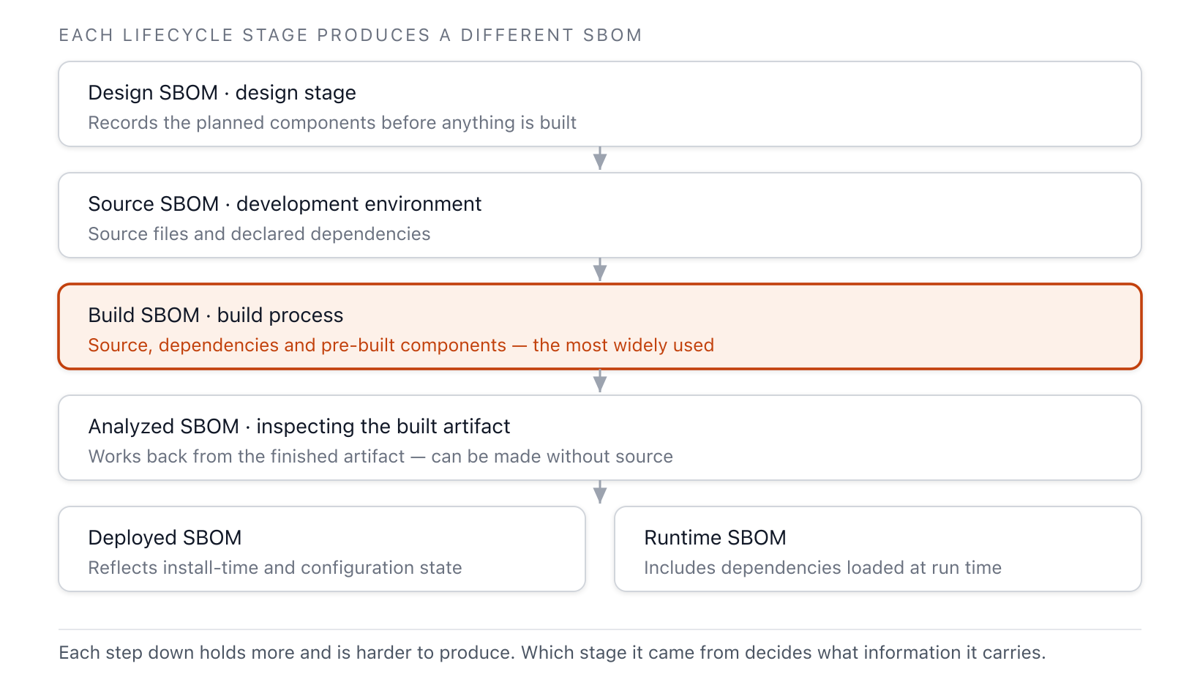
Figure 1. SBOM classification by SDLC stage (source: CISA, Types of Software Bill of Materials
(SBOM), 2023)
- Design SBOM: Records the components planned at the design stage, before the components
actually exist.
- Source SBOM: Reflects the development environment and contains source files and dependencies.
- Build SBOM: Generated during the build process and includes information on source, dependencies,
and pre-built components.
- Analyzed SBOM: Generated by inspecting the final artifact after the build.
- Deployed SBOM: A list of software installed and configured on a specific system, taking the
deployment environment into account as well.
- Runtime SBOM: Monitors components while running, capturing dynamically loaded dependencies and
external interactions as well.
The Build SBOM, generated at build time, is the most widely recommended in terms of accuracy and
automation, because it records exactly what the build tool actually assembled. Generation timing
and automation are covered in detail in 5. Tools and Automation.
Sources
CISA (2023). Types of Software Bill of Materials (SBOM).
https://www.cisa.gov/resources-tools/resources/types-software-bill-materials-sbom (accessed:
June 14, 2026). This is the primary basis for the classification of the six SBOM types (Design,
Source, Build, Analyzed, Deployed, Runtime). For attributes and maturity stages, see CISA (2024).
Framing Software Component Transparency, Third Edition.
https://www.cisa.gov/resources-tools/resources/framing-software-component-transparency-2024. The
EU Cyber Resilience Act’s top-level dependency requirement is based on Regulation (EU) 2024/2847,
Annex I Part II(1).
2 - Standards and Formats
Compares SPDX and CycloneDX, the two standard formats for expressing an SBOM in a machine-readable form.
Since an SBOM requires machine readability, a standard format is necessary. Among the three
formats specified by the US NTIA minimum elements, SPDX and CycloneDX split practical use between
them. The third, the SWID tag, is used mainly in asset management; its role as an identifier is
covered in Identifiers and Licenses.
SPDX
SPDX (System Package Data Exchange) is a project under the Linux Foundation. Version 2.2.1
became an international standard as ISO/IEC 5962:2021 in August 2021. It is worth noting that
the current ISO standard refers strictly to version 2.2.1.
The Linux Foundation released SPDX 3.0 on April 16, 2024, introducing a structure of
purpose-specific profiles. The approach layers Security, Build, Dataset, and AI profiles on top
of a core model. The AI profile carries model training and characterization information, the
Dataset profile carries data provenance and licensing, and the Security profile carries
vulnerability identification, severity, exploitability, and mitigation plans. A patch release,
3.0.1, followed in December of the same year. Whether SPDX 3.x is being re-standardized with ISO
had not been confirmed as of June 2026.
CycloneDX
CycloneDX is a full-stack BOM standard that originated at OWASP (Open Worldwide Application
Security Project). Its distinguishing feature is native support for Vulnerability Exploitability
eXchange (VEX) within the format itself. International standardization proceeded through Ecma
International’s technical committee TC54. Version 1.6 was published as ECMA-424 1st edition in
June 2024, adding a Cryptographic Bill of Materials (CBOM) and CycloneDX Attestations, and v1.7
was announced in October 2025 and standardized as ECMA-424 2nd edition in December 2025. v1.7
added post-quantum cryptography readiness, structured citations, and support for patent objects.
CycloneDX can express software (SBOM), hardware (HBOM), services (SaaSBOM), and machine learning
models (ML-BOM) all within a single format.
| SPDX | CycloneDX |
|---|
| Steward | Linux Foundation | OWASP / Ecma TC54 |
| International standard | ISO/IEC 5962:2021 (based on v2.2.1) | ECMA-424 1st edition (v1.6, 2024-06), 2nd edition (v1.7, 2025-12) |
| Latest specification | 3.0 (2024-04), 3.0.1 (2024-12) | 1.7 (2025-10) |
| Extension mechanism | Purpose-specific profiles (Security, Build, Dataset, AI) | Component types and auxiliary objects, native VEX |
| Strengths | License expression and legal compliance history | Vulnerability/VEX integration, security-operations friendly |
Table 1. Comparison of the two major SBOM standard formats (source: ISO/IEC 5962:2021,
Linux Foundation 2024, Ecma International ECMA-424. Retrieved 2026-06-14)
The two standards differ in design philosophy. SPDX extends its scope of application through
profiles, while CycloneDX expresses it through component types and auxiliary objects. Both,
however, target the same problem in that they carry component identification, licensing, and
dependency relationships. Whichever you choose, conversion tools exist between the two formats,
so you can choose based on the format your trading partners require and the format your own tool
chain supports well. If license compliance is the focus, SPDX is the familiar starting point; if
vulnerability operations is the focus, CycloneDX is.
Next, we look at the minimum elements that define what a format must
contain, and identifiers and licenses for consistently pointing to
components.
Sources
ISO/IEC (2021). ISO/IEC 5962:2021 — SPDX Specification V2.2.1. The Linux Foundation (2024).
SPDX 3.0 Release. https://www.linuxfoundation.org/press/spdx-3-revolutionizes-software-management-in-systems-with-enhanced-functionality-and-streamlined-use-cases.
Ecma International. ECMA-424 — CycloneDX Bill of Materials Specification.
https://ecma-international.org/publications-and-standards/standards/ecma-424/. CycloneDX (2025).
CycloneDX v1.7 Released. https://cyclonedx.org/news/cyclonedx-v1.7-released/. (All retrieved: 2026-06-14)
2.1 - Minimum Elements of an SBOM
Covers the data fields an SBOM must contain, from the NTIA 2021 minimum elements to the CISA 2025 revision draft.
Once a format is chosen, the next question is what that format must contain. The documents that
define this floor are the US Minimum Elements series. Though they are recommendations, they
function as the de facto standard for federal procurement, and SBOM requirements in the EU and
other jurisdictions largely reference this same framework.
Lineage: From NTIA 2021 to CISA 2025
The National Telecommunications and Information Administration (NTIA) published The Minimum
Elements For a Software Bill of Materials (SBOM) in July 2021, under the delegation of
Executive Order 14028. The document organized the minimum elements into three categories: the
data fields to track per component, automation support requiring a machine-readable format, and
practices and processes covering generation frequency, depth, and the like.
Stewardship of the community’s work then moved to the Cybersecurity and Infrastructure Security
Agency (CISA), and two lines of revision followed. One was the third edition (September 2024) of
Framing Software Component Transparency, a reference document that defines attributes, which
added License and Copyright Notice to the baseline attributes. The other was a revision of the
minimum elements document itself: CISA released 2025 Minimum Elements for a Software Bill of
Materials as a public comment draft in August 2025, with the comment period closing on
October 3, 2025. As of June 2026, this revision remains in draft status, and the date of a final
version has not been confirmed.
The Data Fields and Three Categories of NTIA 2021
The NTIA 2021 minimum elements set seven per-component data fields.
| Data field | Description |
|---|
| Supplier Name | The entity that supplied the component |
| Component Name | The name of the component or library |
| Version | The version identifier of the component |
| Other Unique Identifiers | Identifiers such as PURL, CPE |
| Dependency Relationship | The inclusion relationship with the parent component |
| Author of SBOM Data | The entity that generated this SBOM |
| Timestamp | The date and time of generation |
The three categories are as follows.
- Data fields: The seven items above — the basic information for tracking and identifying
components.
- Automation support: Specified SPDX, CycloneDX, and SWID as standard formats for automated
generation and machine readability.
- Practices and processes: Covers generation frequency, depth, handling of known unknowns,
distribution and delivery, access control, and how errors are accommodated.
What the CISA 2025 Draft Adds
The CISA 2025 minimum elements draft expanded the data fields to reflect the maturing state of
tooling. Four core elements were newly added.
| New field | Purpose |
|---|
| Component Hash | Ensures integrity and precise identification through a cryptographic hash |
| License | Primary data for tracking legal compliance |
| Tool Name | Records which tool generated it |
| Generation Context | Records at which stage of the lifecycle it was created |
Existing items were also revised. The roles of SBOM Author and Software Producer were
distinguished, “Other Unique Identifiers” was updated to “Software Identifiers,” and the access
control element, previously separate, was folded into the distribution and delivery item. The
trajectory of License — entering as a baseline attribute in Framing 3rd edition and hardening
into a data field in the 2025 draft — shows that the SBOM is establishing itself as primary data
for open source license compliance, beyond a security inventory. Behind adding Tool Name,
Generation Context, and Hash together lies the concern that an SBOM produced by an untrustworthy
tool cannot itself be trusted. Tool integrity is covered in
5. Tools and Automation.
Practical Recommendations
The minimum elements are, as the name says, a floor. Organizations can, and should, add fields
suited to their own purposes. Carrying CVE references and patch status for vulnerability
identification, SPDX license identifiers and copyright notices for license management, and
release and End-of-Life dates for lifecycle management, together in one SBOM, lets a single SBOM
answer multiple operational questions. If you are introducing an SBOM for the first time,
starting with the NTIA seven fields as a base but including the four new fields from the CISA
2025 draft — especially hash and license — from the outset saves the effort of rebuilding it
later.
Sources
NTIA (2021). The Minimum Elements For a Software Bill of Materials (SBOM).
https://www.ntia.gov/files/ntia/publications/sbom_minimum_elements_report.pdf. CISA (2024).
Framing Software Component Transparency, Third Edition.
https://www.cisa.gov/resources-tools/resources/framing-software-component-transparency-2024.
CISA (2025). 2025 Minimum Elements for a Software Bill of Materials (SBOM) (public comment
draft). https://www.cisa.gov/resources-tools/resources/2025-minimum-elements-software-bill-materials-sbom.
(All retrieved: 2026-06-14)
2.2 - Identifiers and Licenses
Covers the PURL, CPE, and SWID identifiers used to consistently point to components, and how to notate SPDX license identifiers.
If the same component is named differently across SBOMs, automated matching breaks down, because
there is no way for a machine to know that “Apache Tomcat,” “tomcat,” and “Apache Software
Foundation Tomcat” are the same thing. This is why an identifier system that consistently points
to components, and a convention for notating licenses with standard codes, are both necessary.
Three Identifiers: PURL, CPE, SWID
The three identifiers used together in practice serve different roles. They are not mutually
exclusive, so recording them together where possible is recommended.
| Identifier | Maintained by | Primary use |
|---|
| PURL (Package URL) | Community (purl-spec) | Precisely points to a component within a package manager ecosystem |
| CPE (Common Platform Enumeration) | NIST | Notates a product with a consistent name to look up its CVEs |
| SWID (Software Identification Tag) | ISO/IEC 19770-2 | Structured metadata for product, version, and producing entity |
Table 1. Identifiers used together in an SBOM (source: purl-spec, NIST NVD,
ISO/IEC 19770-2. Retrieved 2026-06-14)
A Package URL points to a component within a package manager ecosystem in the following format.
pkg:maven/org.apache.logging.log4j/log4j-core@2.14.1
pkg:npm/lodash@4.17.21
pkg:pypi/requests@2.31.0
After pkg: come the ecosystem type (maven, npm, pypi, etc.), namespace, name, and version.
Because the same component can be pointed to with the same string everywhere, it links
automatically to vulnerability databases and license databases.
CPE was developed by MITRE in the mid-2000s and is now maintained by NIST. It notates products
under a fixed naming rule and is used to look up the vulnerabilities (CVEs) corresponding to a
product. SWID is a tag format standardized as ISO/IEC 19770-2 that structurally describes a
product’s version and producing/distributing entity, and it is mainly used in asset management.
The CISA 2025 minimum elements draft updating “Other Unique Identifiers” to “Software
Identifiers” also reflects the maturing of this identifier ecosystem.
License Notation: SPDX License Identifiers
License management is one of the earliest use cases for an SBOM. Recording exactly which license
each component is distributed under is what prevents obligation violations and conflicts in
advance. Free-text descriptions cannot be matched automatically, so standard codes are used.
SPDX license identifiers assign each license a unique code such as
Apache-2.0, MIT, or GPL-3.0-only. When multiple licenses apply together, they are combined
with a license expression.
Apache-2.0 OR MIT
GPL-2.0-only WITH Classpath-exception-2.0
(MIT AND BSD-3-Clause)
OR indicates a choice among multiple licenses, AND indicates multiple licenses applying
simultaneously, and WITH indicates combination with an exception clause.
The principles to follow in practice are as follows.
- The license of every individual component, not just the license of the product as a whole,
must be visible.
- When encountering a license not on the standard list, assign it an identifier with a prefix
indicating its source (for example, a
LicenseRef- prefix) to track it. - If the license text has been trivially modified but its meaning has not changed materially,
use the same identifier as the original.
- Analyze license compatibility to identify in advance the conflicts that can arise when
combining components under different licenses.
Even when a license field is auto-extracted by a tool, its accuracy is a separate matter.
Precisely identifying non-standard licenses, handling dual licensing, and confirming compliance
with licenses that carry field-of-use restrictions remain the responsibility of people and
policy. The boundary of automation is covered in 5. Tools and Automation.
Sources
Package URL specification https://github.com/package-url/purl-spec. NIST.
Common Platform Enumeration (CPE) https://nvd.nist.gov/products/cpe. ISO/IEC 19770-2:2015.
SPDX License List https://spdx.org/licenses/. SPDX License Expressions
https://spdx.github.io/spdx-spec/v2.3/SPDX-license-expressions/. (All retrieved: 2026-06-14)
3 - Regulatory Trends
Summarizes the regulatory standing of SBOM across jurisdictions, and the US executive order and federal procurement pathway.
The regulatory standing of SBOM differs by jurisdiction. The United States takes an executive-order
pathway that leverages federal procurement, the European Union takes a directly effective
legislative pathway, and most other countries remain at the stage of advisory guidelines. This
section covers the United States first, followed by the
EU Cyber Resilience Act and
other jurisdictions such as India and Korea.
Regulatory Standing by Jurisdiction at a Glance
| Jurisdiction | Document/Legislation | Standing | SBOM Requirement |
|---|
| United States | Executive Order 14028 (2021), CISA minimum elements | Federal procurement recommendation | SBOM provision for software delivered to the federal government |
| European Union | Cyber Resilience Act, Regulation (EU) 2024/2847 | Legal obligation (with fines) | Annex I Part II, top-level dependencies, machine-readable |
| India | CERT-In Technical Guidelines (2024) | Voluntary recommendation | Best practices for government and essential services |
| Korea | Software Supply Chain Security Guideline 1.0 (2024) | Administrative recommendation | Recommended SBOM generation and review procedures |
Table 1. SBOM regulatory standing in major jurisdictions (source: primary source for each
item; collected June 14, 2026)
United States: Leveraging Federal Procurement
US SBOM policy originates from an executive order. On May 12, 2021, shortly after the SolarWinds
incident, Executive Order 14028 (“Improving the Nation’s Cybersecurity”) was signed and published
in the Federal Register as 86 FR 26633. Section 10(j) of the order defined SBOM as “a formal record
containing the details and supply chain relationships of various components used in building
software,” and Section 4(f) directed the Secretary of Commerce, working with NTIA, to publish
minimum elements for an SBOM within 60 days. This was the moment SBOM was elevated from a
recommendation of the research community to a candidate requirement for federal procurement.
Under this mandate, NTIA published the minimum elements in July 2021, and responsibility for the
work subsequently moved to CISA. Under Office of Management and Budget (OMB) Memorandum M-22-18,
CISA holds the authority to update the NTIA minimum elements and has focused on tooling and
operationalization. The results are the 2024 Framing Software Component Transparency, Third
Edition, and the 2025 draft revision of the minimum elements. Changes in the data fields between
the two documents are covered in Minimum Elements.
It is important to understand the exact nature of the US pathway. Executive Order 14028 is the
basis for guidance requiring vendors that supply software to the federal government to provide an
SBOM; it is not a general statute that applies to all software. CISA’s two documents themselves
state that they do not create new federal requirements. The normative standing remains that of a
procurement criterion and technical reference. Nonetheless, because the vast federal procurement
market operates on this basis, it functions as a de facto requirement for companies that supply
software to the US government.
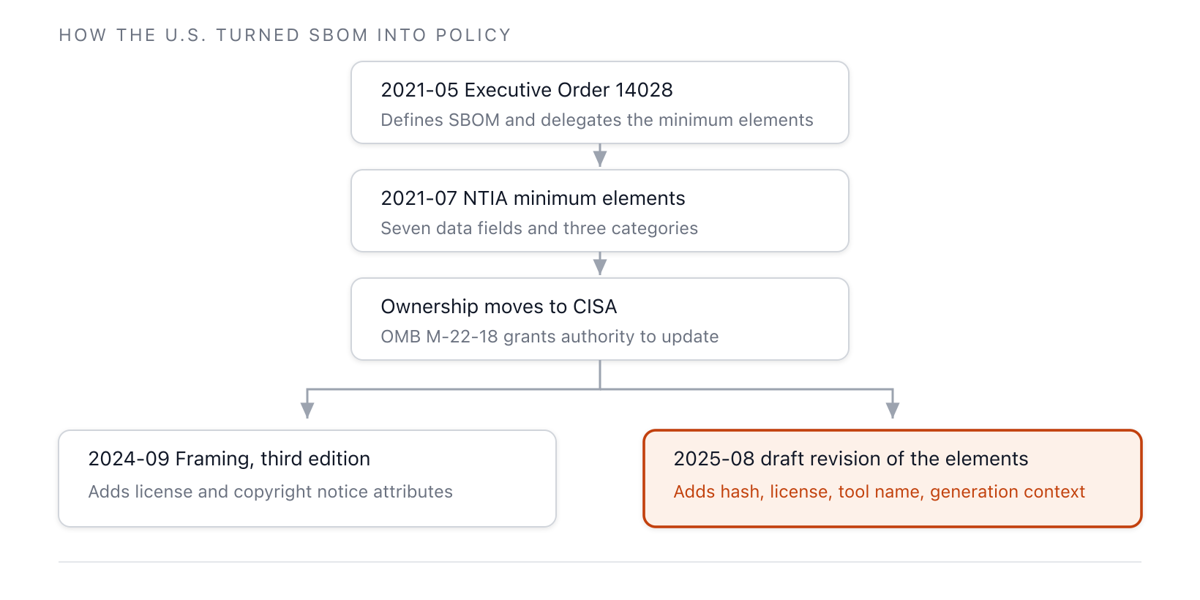
Figure 1. Lineage of US SBOM policy documents (source: Executive Order 14028, NTIA 2021, CISA
2024 and 2025; collected June 14, 2026)
Sources
The White House (2021). Executive Order 14028 — Improving the Nation’s Cybersecurity, 86 FR
26633.
https://www.federalregister.gov/documents/2021/05/17/2021-10460/improving-the-nations-cybersecurity.
OMB (2022). M-22-18.
https://www.whitehouse.gov/wp-content/uploads/2022/09/M-22-18.pdf. CISA SBOM Resource Hub
https://www.cisa.gov/sbom. (all accessed: June 14, 2026)
3.1 - EU Cyber Resilience Act (CRA)
Summarizes the SBOM requirements and implementation timeline of the EU Cyber Resilience Act, the first major legislation to establish SBOM as a legal obligation.
The first major piece of legislation to establish SBOM as an explicit legal obligation is the EU
Cyber Resilience Act (CRA, Regulation (EU) 2024/2847). Whereas the United States effectively
mandates SBOM through the market of federal procurement, the CRA is a directly effective law that
applies horizontally across products with digital elements.
Legal Basis of the SBOM Obligation
In the CRA, the SBOM obligation appears in Annex I, Part II (vulnerability handling requirements),
point (1). Manufacturers must identify and document the vulnerabilities and components contained
in a product, and as a means of doing so, the CRA specifies that they must “draw up a software
bill of materials, in a commonly used and machine-readable format, covering at the very least the
top-level dependencies of the product.”
Two points that matter in practice differ from the US pathway.
- The scope of the obligation is top-level dependencies: There is no obligation to expand the
entire dependency tree; covering at least the top-level dependencies is sufficient. That said,
going deeper than this is clearly the recommended direction.
- It is an obligation to retain and submit, not to disclose: There is no obligation to disclose the
SBOM to the general public. It is sufficient to retain it so that it can be submitted when a
market surveillance authority makes a reasoned request.
The core of the CRA is that producing an SBOM is not a recommendation but a legal obligation backed
by a system of fines.
Implementation Timeline
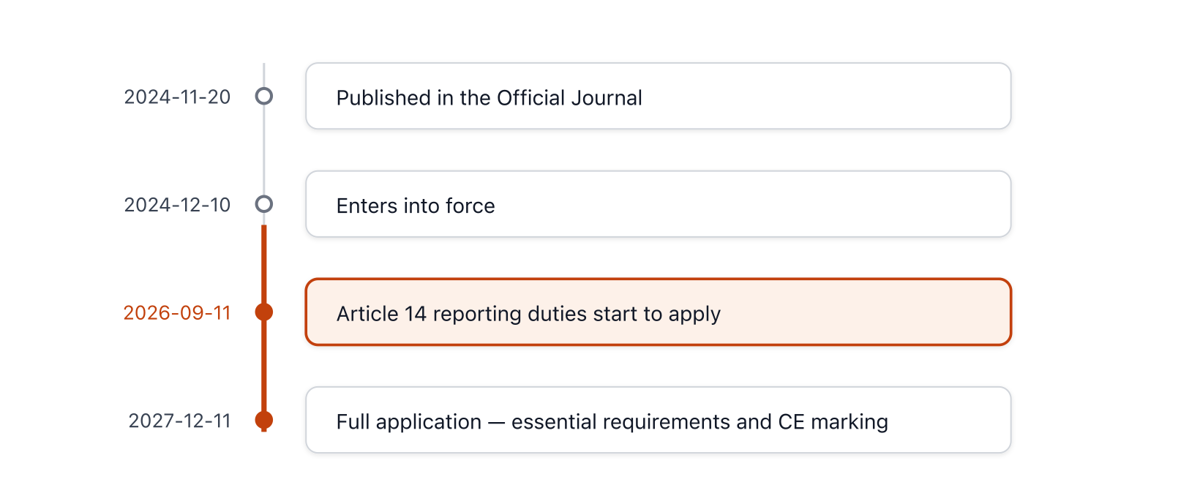
Figure 1. Phased implementation timeline of the EU CRA (source: Regulation (EU) 2024/2847;
collected June 14, 2026)
The CRA was published in the Official Journal on November 20, 2024, and entered into force on
December 10, 2024. Its application is staged: the Article 14 obligation to report exploited
vulnerabilities and severe incidents applies from September 11, 2026, and full application of the
essential cybersecurity requirements, including SBOM, begins on December 11, 2027.
As of June 2026, no official CRA-level implementing rule for SBOM format has been published. This
means there is not yet a document that establishes, as an EU-wide binding norm, which schema and
fields must be used to conform to the CRA.
The current practical reference point is Technical Guideline TR-03183-2 v2.1.0, published in
August 2025 by Germany’s Federal Office for Information Security (Bundesamt für Sicherheit in der
Informationstechnik, BSI). This document provides specific field mappings for CRA-conformant SBOM
for both CycloneDX and SPDX. Note, however, that this is a German guideline, not an EU-wide binding
norm.
Considerations for Open Source
The CRA uses commercial activity as its applicability criterion, and in principle excludes
non-commercial open source that is distributed free of charge without commercial activity. This is
a mechanism to avoid imposing manufacturer-level obligations directly on open source maintainers.
However, the obligations still apply in full to manufacturers who integrate open source into a
product and supply it commercially, so obtaining and managing SBOMs for open source components
remains the manufacturer’s responsibility.
Sources
European Parliament and Council (2024). Regulation (EU) 2024/2847 — Cyber Resilience Act. OJ L,
2024/2847, 20.11.2024. https://eur-lex.europa.eu/eli/reg/2024/2847/oj/eng. European Commission,
DG CNECT. Cyber Resilience Act.
https://digital-strategy.ec.europa.eu/en/policies/cyber-resilience-act. BSI. Technical Guideline
TR-03183-2. (all accessed: June 14, 2026)
3.2 - India, Korea, and Other Jurisdictions
Summarizes SBOM recommendation guidelines from India’s CERT-In and other jurisdictions, including Korea.
Jurisdictions outside the United States and the European Union are generally at the recommendation
stage. There is no legal enforcement or sanction, but these function as best practices that
influence procurement and contracting practices.
India: CERT-In Technical Guidelines
The Indian Computer Emergency Response Team (CERT-In) published the Technical Guidelines on
Software Bill of Materials (SBOM). This is a voluntary guideline aimed at government agencies,
the public sector, essential services, and software producing and service companies, covering the
value of SBOMs, best practices, minimum elements, and vulnerability tracking procedures. It has no
legal force, but it influences government procurement and contracting practices.
In July 2025, CERT-In expanded this guideline to also cover Quantum BOM (QBOM), Cryptography BOM
(CBOM), AI BOM (AIBOM), and Hardware BOM (HBOM). This is an example of how the bill of materials
concept is spreading beyond software into cryptography, AI, and hardware. The expansion into AI
BOM is covered further in 5. Tools and Automation and in the separate
AI SBOM Compliance Guide.
The first edition of this guide began as a Korean translation of this CERT-In document. The
current edition updates that skeleton with current primary sources from the United States and the
European Union, and broadens it to a general practitioner’s perspective.
Korea: Software Supply Chain Security Guidelines
In Korea, the Ministry of Science and ICT, the National Intelligence Service, and the Korea
Internet & Security Agency (KISA), among others, published the Software Supply Chain Security
Guidelines 1.0 in May 2024. It recommends SBOM generation and vulnerability inspection procedures,
and the use of the National Institute of Standards and Technology (NIST) Secure Software
Development Framework (SSDF).
However, this is only an administrative guideline, and Korea’s current legal system does not yet
have legislation that imposes a mandatory reporting obligation at the product level, as the EU
Cyber Resilience Act does. Even so, Korean companies exporting software to the EU and the United
States must directly meet the requirements of those markets, so building SBOM capability is a
practical necessity regardless of domestic regulation.
Practical Implications
The legal standing differs by jurisdiction, but the skeleton of the data required converges. A
well-built SBOM system, built once, can satisfy the requirements of multiple jurisdictions at the
same time. If the system is designed around the strictest requirement among your export markets
(currently the EU CRA), the recommendations of other jurisdictions are largely subsumed within it.
Sources
Indian Computer Emergency Response Team (CERT-In). Technical Guidelines on Software Bill of
Materials (SBOM), CIGU-2024-0002. https://www.cert-in.org.in/. Ministry of Science and ICT,
National Intelligence Service, Korea Internet & Security Agency (2024). Software Supply Chain
Security Guidelines 1.0. https://www.kisa.or.kr/. (all accessed: June 14, 2026)
4 - Adoption Roadmap
Summarizes the activities organizations undertake to build an SBOM program in stages, from establishing the foundation to operational maturity.
Introducing an SBOM program into an organization is not a one-time effort. A staged approach is
more realistic: establish the foundation (Foundational), settle generation and integration into
practice (Developing), and mature operations (Scaling). The stage breakdown below is the common
framework presented by both the US NTIA and India’s CERT-In guidelines; the order of activities is
only illustrative and can be adjusted to fit an organization’s security needs, timeline, and
resources.
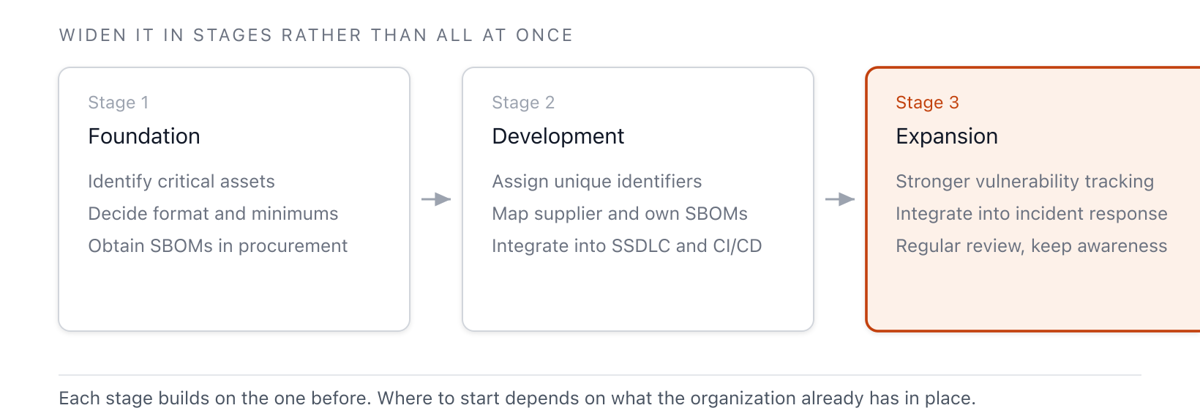
Figure 1. The three stages of SBOM adoption (source: reconstructed from NTIA 2021 and CERT-In
technical guidelines; collected June 14, 2026)
Stage 1: Building the Foundation
The first SBOM an organization encounters is usually one received from a supplier during
procurement. The purpose of this stage is to establish how the organization handles SBOM in the
first place.
- Identify critical assets and establish a plan: Develop a plan that defines roles and
responsibilities, timelines, and resource requirements, and obtain stakeholder buy-in for the new
process.
- Decide on the format and minimum requirements: Before creating SBOMs, determine the format (SPDX
or CycloneDX) and the minimum data requirements. This ensures a standard structure that can be
processed consistently across the supply chain.
- Identify security requirements, storage, and tools: Define classification and handling
procedures, and set up a secure repository for SBOMs.
- Obtain SBOMs through procurement: Specify the requirement for suppliers to provide SBOMs in
purchase orders or contracts, and specify which elements are to be provided, when, and by what
method.
Stage 2: Generation and Integration
This stage involves establishing secure configuration management, consistently referencing
components with unique identifiers, and embedding generation itself into the development process.
- Assign unique identifiers: Pin each component with
an identifier such as PURL so that traceability is not lost even
if a supplier or component name changes, or a different version is released under the same name.
- Map supplier SBOMs to internal SBOMs: Create internal SBOMs based on the SBOMs suppliers provide,
and record the author and timestamp to manage integrity and update history.
- Integrate with the SSDLC and CI/CD: Integrate SBOM generation into the Secure Software
Development Life Cycle (SSDLC) and continuous integration/continuous deployment (CI/CD) pipeline.
Generating SBOMs automatically at build time improves both accuracy and timeliness. See
5. Tools and Automation for tool selection.
- Secure configuration management: Apply access control, encryption, and regular audits to manage
SBOMs securely.
Stage 3: Operational Maturity and Scaling
The final stage involves fully weaving SBOM into vulnerability management and incident response,
and continuously updating the program.
- Strengthen vulnerability tracking: Establish a process for cross-referencing SBOM components
against vulnerability databases to assess impact and mitigation. Detailed methods are covered in
6. Vulnerability Management.
- Integrate incident response: Establish a process for using SBOM to quickly determine, for a newly
disclosed vulnerability, whether the organization is affected or has already been compromised.
- Maintain regular review and awareness: Periodically check that components and dependencies match
the latest records, and keep the organization aware of new formats, data elements, and industry
trends.
Choosing a Starting Point
Follow the three stages in order, but there is no need to aim for perfection from the start. A
realistic first step is to pick one or two of the most important products, automatically generate
SBOMs in the build pipeline, and feed them into a vulnerability scanner. Once you confirm the
program works for one product, expanding it across the full portfolio reduces the cost of trial and
error.
Sources
NTIA (2021). The Minimum Elements For a Software Bill of Materials (SBOM). CERT-In. Technical
Guidelines on Software Bill of Materials (SBOM). CISA SBOM Resource Hub
https://www.cisa.gov/sbom. (all accessed: June 14, 2026)
5 - Tools and Automation
Covers SBOM generation, management, and scanning tools, and where automation ends and human responsibility begins.
An SBOM workflow is not completed by a single tool. The three capabilities of generation,
vulnerability matching, and lifecycle management are split across different tools, and the
common conclusion of recent tool comparison analyses is that no single tool covers all three
areas completely. It is more accurate to think of it as assembling a pipeline from a combination
of tools.
The Division of Labor Among Generation, Management, and Scanning
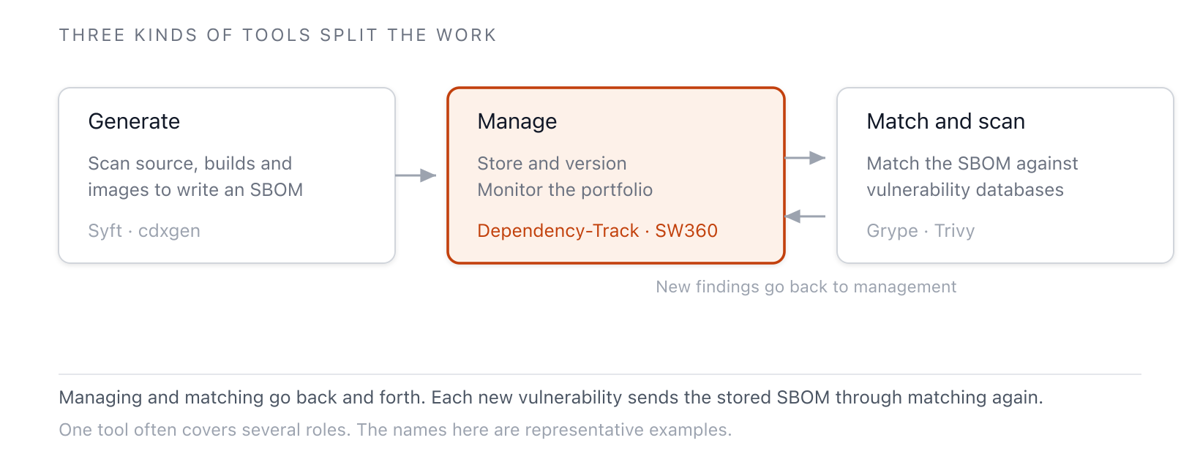
Figure 1. The three roles of SBOM tools (source: compiled from tool comparison analyses,
2026-01. Retrieved 2026-06-14)
In the generation space, Anchore’s Syft is regarded as “the dedicated tool that does SBOM
generation, and only that, best.” Its attestation workflow, combined with the signing tool
cosign, is mature. OWASP CycloneDX’s cdxgen is distinguished by broad support for multiple
languages and container images, and by a dedicated AI BOM mode.
In the management space, OWASP Dependency-Track has established itself as a platform for
monitoring component usage and security/license compliance across an organization’s entire
application portfolio. Eclipse SW360 is another option centered on license compliance.
In the scanning space, Grype takes an SBOM as input and matches it against vulnerabilities,
while Aqua Security’s Trivy is both a scanner and an SBOM generator.
| Role | Representative open source tools | Characteristics |
|---|
| Generation | Syft, cdxgen | Syft is generation-only with mature attestation; cdxgen offers multi-language support and an AI BOM mode |
| Management | Dependency-Track, SW360 | Portfolio monitoring, license and vulnerability tracking |
| Matching/Scanning | Grype, Trivy | Matches an SBOM against a vulnerability database |
Table 1. Classification of SBOM tools by role (source: compiled from tool comparison
analyses, 2026-01. Retrieved 2026-06-14)
How Far Does Automation Go
It is important to honestly distinguish between areas where automation works well and areas that
people must fill in.
| Task | Automation maturity |
|---|
| Code/dependency SBOM generation | Mature |
| Container image component identification | Mature |
| SBOM storage and vulnerability monitoring | Mature |
| Automated license identifier extraction | Partial (requires review) |
| Interpreting non-standard licenses and tracking compliance | Immature (people/policy) |
Table 2. Automation maturity of SBOM tasks (source: compiled from tool comparison analyses.
Retrieved 2026-06-14)
Tools do generation well. Put Syft or cdxgen into the build pipeline, and the component list
fills in automatically. But whether the license field of a generated SBOM is accurate, whether
the obligations of a non-standard license are met, and whether obligations propagate downstream
without omission are things no tool guarantees automatically. This area is filled by policy and
human review.
Before trusting an automation tool, its own integrity must be verified. In January 2026, a case
was reported in which an SBOM tool was implicated in two supply chain attacks within a short
period, with the damage spreading to downstream projects. On this basis, some pipeline operators
removed the tool in question.
The fact that an SBOM generation tool can itself become a target of supply chain risk requires
combining hashes, signatures, and attestations at the generation and verification stages. This
same concern lies behind CISA’s 2025 minimum elements draft adding Tool Name, Generation Context,
and Component Hash as new fields. Avoiding the paradox that “an SBOM made by an untrustworthy
tool cannot be trusted” requires pinning tool versions, verifying provenance, and signing the
output.
Sources
Anchore. Syft https://github.com/anchore/syft, Grype https://github.com/anchore/grype.
OWASP. cdxgen https://github.com/CycloneDX/cdxgen, Dependency-Track
https://dependencytrack.org/. Aqua Security. Trivy
https://github.com/aquasecurity/trivy. Eclipse SW360 https://www.eclipse.org/sw360/.
(All retrieved: 2026-06-14)
6 - Vulnerability Management and VEX
Covers how to link an SBOM to vulnerability data for tracking, and the VEX/CSAF framework for exchanging exploitability information.
The most direct use of an SBOM is vulnerability management. With a component list in hand,
affected assets can be looked up immediately when a new vulnerability is disclosed. But listing
components in an SBOM brings along every past CVE for those components, creating a problem of
exploding false positives. Vulnerability Exploitability eXchange (VEX) is what solves this
problem.
SBOM-Based Vulnerability Tracking
The basic flow of tracking is simple. Each component in an SBOM is matched against vulnerability
databases (NVD, CVE) using an identifier such as PURL or CPE to
map known vulnerabilities. A supplier can pre-map vulnerability information into an SBOM and
provide customers with an enriched SBOM, while a consumer can link its own SBOM to vulnerability
data through an API or data feed to set response priorities.
To increase effectiveness, a shift-left approach that moves checks earlier in development is
recommended. Integrating security tools into the development pipeline and automatically
analyzing SBOM data at early stages such as build and packaging catches vulnerabilities before
release.
VEX: Sorting Out Exploitability
VEX is a document in which a manufacturer asserts “is this vulnerability actually exploitable in
our product,” helping consumers make priority judgments. Where an SBOM answers “what is inside,”
VEX answers “does a known vulnerability inside actually affect this product.” Even if a
component has a vulnerability, it may be unexploitable if the affected code path is never
invoked; VEX states this status explicitly, reducing unnecessary response effort.
A VEX document notates the vulnerability status of a specific product using the following four
states.
- Not affected: No remediation is needed for this vulnerability.
- Affected: A fix or mitigating action is recommended.
- Fixed: The vulnerability fix is included in the given product version.
- Under Investigation: Whether the product is affected has not yet been confirmed and will be
updated later.
VEX is not a single format; CSAF VEX, OpenVEX, and CycloneDX VEX coexist. CycloneDX is
distinguished by expressing VEX natively within the format itself.
CSAF: Structuring Advisories
Common Security Advisory Framework (CSAF) 2.0 is a standard that structures security advisories
in a machine-readable form, and it includes a VEX profile. OASIS approved it as a formal
standard in November 2022. Where VEX communicates exploitability status, CSAF delivers a
detailed advisory that includes a vulnerability description, affected versions, a severity
assessment (CVSS score), and recommended mitigation steps.
The practical turning point for adoption was Red Hat. Red Hat’s Product Security team began
publishing CSAF/VEX files for every CVE in its database in 2023, and has since moved to full
production, publishing them on an ongoing basis.
Case Study: Log4Shell
The Log4j vulnerability (Log4Shell), disclosed in December 2021, is a case that shows how SBOM,
VEX, and CSAF interlock.
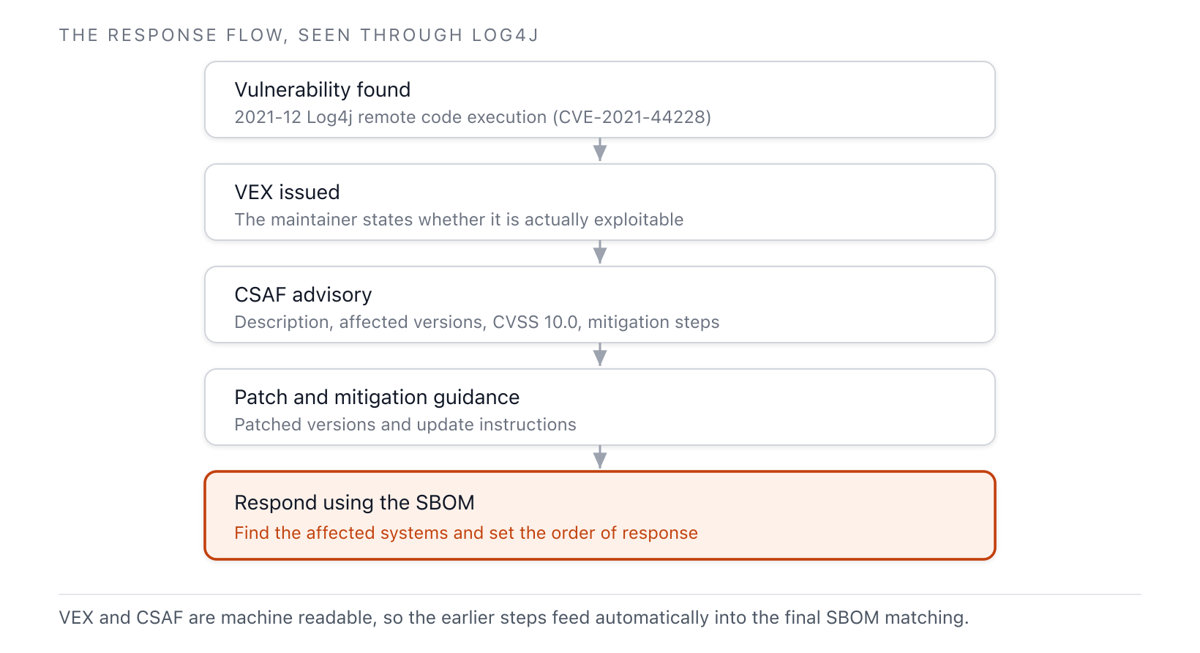
Figure 1. The interplay of SBOM, VEX, and CSAF in the Log4Shell response (source:
reconstructed from CERT-In technical guidelines. Retrieved 2026-06-14)
When the vulnerability was disclosed, maintainers issued a VEX stating the exploitable status,
followed by a CSAF advisory containing the vulnerability description, affected versions, CVSS
10.0 (the highest severity), and mitigation steps. Organizations that included Log4j as a
component integrated this VEX and CSAF data into their own SBOMs, identifying the affected parts
of their systems and setting response priorities. The core point of this case is that, had an
SBOM already been in place, “where is Log4j” could have been answered with a single query.
Sources
OASIS Open (2022). CSAF 2.0. https://www.oasis-open.org/2022/11/21/new-version-of-csaf-standard/.
CISA. Vulnerability Exploitability eXchange (VEX). https://www.cisa.gov/sbom. OpenVEX
https://github.com/openvex. NVD. CVE-2021-44228. https://nvd.nist.gov/vuln/detail/CVE-2021-44228.
Red Hat (2023). VEX files now available. (All retrieved: 2026-06-14)
7 - Sharing and Governance
Summarizes SBOM access control and disclosure scope, secure sharing channels, and roles-and-responsibilities governance.
An SBOM creates value only when it is delivered along the supply chain, but it is also sensitive
material that contains trade secrets and attack surface. Without governance that determines who
shares what, and how, excessive disclosure heightens risk, and excessive restriction forfeits value.
Access Control and Disclosure Scope
Access to SBOM data is managed through Role-Based Access Control (RBAC). Because access needs
differ by stakeholder, general users are granted read-only access, administrators are granted edit
and update access, and sensitive information is granted restricted access.
For disclosure scope, maintaining two versions is common practice.
- Public SBOM: Contains non-sensitive information that can be shared with all stakeholders.
- Private SBOM: Contains sensitive information, such as vulnerabilities, and only approved parties can access it.
Regulation reflects this distinction as well. The EU Cyber Resilience Act does not require an SBOM
to be disclosed to the general public, but requires it to be retained in case market surveillance
authorities request it. Amid the tension between consumers wanting a more complete SBOM and
producers wanting to reduce disclosure, the public/private split is a practical device that
reconciles the two.
Secure Sharing Channels
When delivering an SBOM, both integrity and confidentiality need to be preserved.
- Use a secure protocol such as HTTPS for transmission, and ensure integrity and confidentiality through digital signatures or encryption.
- Use a sharing platform equipped with access control and audit capabilities.
- Use API integration for automated exchange between systems, and dedicated repositories for industry- or community-level sharing.
Attach a digital signature to the document so recipients can verify its authenticity and check for
tampering, and clearly mark which information is public and which is private.
Roles and Responsibilities
An SBOM program works only when multiple departments share responsibility for it. It should
include an executive sponsor, project leads, systems and design engineers, procurement
specialists, and operations personnel, adding IT, cybersecurity, and maintenance staff as security
needs require. When roles are scattered, responsibility scatters with them, so establishing clear
ownership is the starting point.
The key activities in building governance are as follows.
- Identify key stakeholders: Include representatives from development, IT operations, security,
procurement, legal, and business leadership, and be sure to include a cybersecurity expert.
- Define responsibilities and assign ownership: Decide who will handle SBOM generation and
consumption, vulnerability monitoring, supplier engagement, and security data management, and
designate a cybersecurity expert as the program owner or co-owner.
- Establish a governance structure: A governance body with participation from stakeholders across
the organization develops policies, standards, and processes, and implements data protection
controls.
- Train and monitor: Train personnel on SBOM security requirements and secure data handling, and
continuously assess the program’s security posture through regular audits, adjusting it to
evolving threats and compliance requirements.
Sources
CISA (2024). Framing Software Component Transparency, Third Edition. CERT-In. Technical Guidelines
on Software Bill of Materials (SBOM). Regulation (EU) 2024/2847 — Cyber Resilience Act, Annex I
Part II. (all accessed: June 14, 2026)
8 - Recommendations and Checklist
Collects the key recommendations from the preceding sections and provides a checklist for reviewing SBOM adoption.
This section organizes the content covered in the preceding sections into practical
recommendations and a checklist. Organizations adopting SBOM for the first time can follow the
checklist in order, while organizations already operating one can use it to check for missing
items.
Key Recommendations
Procurement and Generation
- When procuring software, specify the SBOM provision requirement in contracts and purchase terms.
Specify which elements are to be provided, in what format, and when.
- Generate SBOMs in the SPDX or CycloneDX format, choosing based on your counterparty’s
requirements and your own toolchain.
- Automatically generate SBOMs at build time within the SSDLC and CI/CD pipeline to ensure
accuracy and timeliness.
- Put in place a workflow to regenerate the SBOM whenever a new component is introduced or an
existing component is updated.
Data Quality
- Include complete metadata such as component name, version, license, and unique identifier.
Because the minimum elements are only a floor, add fields to fit your own use case.
- Pin components with PURL or CPE so that traceability is not lost
even when names or versions change.
- Pin the version of the generation tool, verify its provenance, and attach hashes and signatures
to the output to ensure integrity.
Vulnerabilities and Licenses
- Link the SBOM to vulnerability databases and advisories to maintain continuous visibility into
security posture.
- Reflect any applied patches or mitigations in your own SBOM.
- Exchange vulnerability exploitability status using VEX and CSAF, and prioritize response based on
risk.
- Analyze the license compatibility of all components to identify conflicts that may arise from
combining them, in advance.
Storage and Operations
- Store and transmit SBOMs securely using encryption and access control, and clearly distinguish
between public and private scope.
- Check the accuracy and completeness of SBOMs through regular audits.
- Run training and awareness programs on the role of SBOM, from developers to the security team.
Adoption Checklist
A checklist for reviewing what has been done at each stage.
| Stage | Checklist Item |
|---|
| Foundational | Identify critical assets and establish an adoption plan |
| Foundational | Decide on the SBOM format (SPDX/CycloneDX) and minimum data requirements |
| Foundational | Select a secure repository and tools |
| Foundational | Reflect the SBOM provision requirement in procurement contracts |
| Developing | Assign unique identifiers to components |
| Developing | Map supplier SBOMs to internal SBOMs |
| Developing | Integrate automatic SBOM generation into the build pipeline (CI/CD) |
| Developing | Apply secure configuration management, including access control and encryption |
| Scaling | Track SBOM linked with vulnerability databases |
| Scaling | Integrate VEX/CSAF-based exploitability management with incident response |
| Scaling | Run regular review, audits, and awareness programs |
Next Steps
If you develop AI systems or exchange them across the supply chain, you need to add an AI-specific
layer — models, datasets, and training compute — on top of the SBOM capabilities covered in this
guide. The component, license, and vulnerability management practices of a general SBOM carry over
directly into the software layer of an AI BOM. This is covered in detail in the separate
AI SBOM Compliance Guide.
Sources
NTIA (2021). The Minimum Elements For a Software Bill of Materials (SBOM). CISA (2024). Framing
Software Component Transparency, Third Edition. CERT-In. Technical Guidelines on Software Bill of
Materials (SBOM). Regulation (EU) 2024/2847 — Cyber Resilience Act. (all accessed:
June 14, 2026)